

Urban heat increasingly limits the safe and comfortable use of streets, parks, and other public open spaces during warm periods. Urban trees are a central component of climate-responsive landscape design because their canopies modify direct solar exposure, mean radiant temperature, wind, evapotranspiration, and surface-atmosphere exchange. Their thermal performance depends not only on the presence of vegetation but also on crown geometry, foliage density, planting arrangement, and surrounding surface properties [1,2]. Physiological Equivalent Temperature (PET) provides a human-energy-balance measure that integrates air temperature, humidity, wind, and radiation [3], while ENVI-met enables controlled assessment of interactions among vegetation, surfaces, buildings, and the atmosphere [4].
The design problem is not simply whether trees reduce heat exposure, but which complete canopy and surface configurations perform favorably under seasonally contrasting conditions. A configuration that reduces warm-season PET may also restrict desirable solar access and lower cool-season PET. Interpretation is further complicated when albedo, leaf area density (LAD), species representation, and crown form change simultaneously, because the resulting PET difference cannot be attributed to one characteristic. In addition, PET values are sensitive to receptor position, simulation timing, meteorological forcing, and personal BIO-met assumptions; incomplete reporting of these settings limits reproducibility and site-specific inference.
Previous empirical and ENVI-met studies have established that tree geometry, LAI/LAD, planting pattern, wind conditions, and detailed crown representation influence pedestrian thermal exposure [5,6]. Tehran field studies have also demonstrated seasonal adaptation and differences between generic thermal-stress classifications and locally observed sensation [7]. However, limited evidence is available on the warm- and cool-season PET performance of contrasting bundled canopy configurations in Tehran’s urban parks. The literature also rarely distinguishes clearly between comparisons of complete configurations and causal estimates of individual tree traits, and incomplete documentation of receptor, plant, and BIO-met parameters often weakens reproducibility.
This study addresses these issues through a transparent ENVI-met scenario comparison of a no-tree asphalt baseline and three complete surface-canopy configurations associated with representative domains in Mellat Park and Saei Park. Absolute PET differences are used instead of percentage changes, warm- and cool-season results are reported separately, and no independent effect is assigned to albedo, LAD, species, or crown form. Available simulation information is separated explicitly from unavailable metadata so that the analysis does not imply park-specific, receptor-level, temporal, or causal precision that the retained record cannot support. Tehran combines hot summers, cool winters, water constraints, heterogeneous park structures, and documented seasonal adaptation in outdoor thermal perception [8]. These conditions create a practical need for canopy-planning approaches that consider summer shade, winter solar access, and ventilation together. The study is motivated by the need for locally contextualized and methodologically cautious evidence that can support early-stage landscape screening without overstating the predictive accuracy of unvalidated simulation summaries.
The study aims to evaluate how the four retained surface-canopy configurations differ in PET under warm- and cool-season conditions. Its specific objectives are to: (1) quantify the absolute change in PET for each vegetated configuration relative to the no-tree baseline; (2) compare the seasonal direction and magnitude of those changes; (3) interpret the configurations as bundled scenarios rather than isolated trait effects; and (4) define the conclusions that remain supportable when park-specific receptor outputs and several model parameters are unavailable. The study contributes a Tehran-focused, seasonally explicit comparison of complete tree-canopy configurations and provides a clear audit of result provenance and parameter availability. Its principal advantages are the use of a single objective thermal-comfort outcome, consistent scenario-level comparison, emphasis on absolute PET change, avoidance of unsupported causal attribution, and explicit separation of observed results from missing metadata. This framework strengthens interpretive transparency and provides a defensible basis for future field-validated, receptor-level, and factorial investigations of urban-park canopy design.
Recent research has progressively shifted from representing urban trees as simple porous objects toward more explicit treatment of crown architecture and radiative processes. Simon et al. [9] introduced fractal-based tree digitalization and an advanced in-canopy radiation-transfer scheme in ENVI-met. Their 2020 study demonstrated that crown geometry, leaf-cluster distribution, LAD, and the treatment of diffuse and scattered radiation can materially change simulated plant and microclimate responses. This work establishes that reproducible thermal-comfort analysis requires more than a species name or a single nominal LAD value; the three-dimensional tree representation and its optical assumptions must also be documented.
At the park and neighborhood scale, Chan and Chau [10] used ENVI-met to examine urban parks in Hong Kong in 2021 and showed that solar altitude and tree coverage were major determinants of thermal conditions during sunlit periods, while the relevant park and surrounding-building variables differed between summer and winter. In a steppe-climate urban park, Teshnehdel et al. [11] combined field observations and scenario analysis in 2022 to evaluate trees and water. They found that tree shade strongly reduced mean radiant temperature and improved daytime thermal comfort, whereas the contribution of water depended on its placement, scale, and time of day. Together, these studies show that canopy performance is seasonal and spatially contingent rather than universally transferable.
Research in hot and semi-arid settings has further emphasized interactions between vegetation and urban form. Abdelmejeed and Gruehn [12] evaluated urban morphology and tree strategies in Cairo in 2023 using ENVI-met and reported that optimized tree placement and shading can substantially improve pedestrian thermal conditions, with effectiveness varying by street geometry and time. In Tehran, Azimi et al. [13] conducted field measurements and validated ENVI-met simulations for an open transitional space in 2024. Their warm- and cool-season comparison showed that trees generally improve summer PET but can reduce desirable winter solar exposure, and that MRT, wind speed, and sky-view conditions are important to seasonal interpretation. The Tehran evidence is especially relevant because it cautions against equating every numerical reduction in PET with improved year-round comfort. More recent studies have moved toward multi-season configuration optimization and improved model realism. Qin and Zhou [14] compared 15 vegetation arrangements in a hot-summer/cold-winter courtyard in 2025 and found that mixed evergreen-deciduous planting and spatial configuration affected seasonal PET differently, reinforcing the need to balance summer shade with winter radiation access. In 2026, Simon et al. [15] compared alternative tree representations in ENVI-met simulations in Augsburg and showed that the selected representation influences modeled urban-climate outcomes. This finding strengthens the methodological case for reporting plant-database entries, crown dimensions, foliage distribution, and radiation parameters when scenario rankings are interpreted.
Liu et al. [16] investigated the combined effects of tree height and spatial layout on pedestrian thermal comfort in a residential area in Qingdao. Using field observations and a validated ENVI-met model, they demonstrated that thermal performance depends not only on the presence of trees but also on their height, spacing, and arrangement relative to buildings and pedestrian spaces. Some configurations improved shading and reduced PET, whereas poorly positioned trees could restrict ventilation or increase radiant exposure. Their findings reinforce the importance of evaluating tree geometry and planting layout as an integrated configuration rather than interpreting individual canopy characteristics in isolation.
Gregorčič et al. [17] combined interdisciplinary field measurements with ENVI-met simulations to compare outdoor thermal comfort across different Local Climate Zones. They found substantial spatial differences in heat exposure, with a mean PET difference of 12.44 \(\mathrm{{}^\circ}\)C between the coolest and warmest investigated zones. Existing tree shade reduced PET by an average of 8.43 \(\mathrm{{}^\circ}\)C compared with locations exposed to direct solar radiation. The study highlights the importance of receptor location, urban morphology, field validation, and explicit distinction between shaded and sun-exposed conditions when interpreting configuration-level PET results. Goossens et al. [18] used field-validated ENVI-met simulations to assess the transformation of a paved parking area into a vegetated urban park in Antwerp. Mature vegetation reduced peak air temperature by approximately 1.2 \(\mathrm{{}^\circ}\)C and PET by 4.6 \(\mathrm{{}^\circ}\)C, while also shortening the duration of extreme heat stress. Clustered tall trees with high LAD produced the strongest thermal benefits, although irrigation, water stress, canopy continuity, and ventilation corridors affected performance. The authors identified a Tree View Factor of approximately 0.4 as a useful threshold for avoiding extreme heat stress, demonstrating that effective park cooling results from interactions among shade, evapotranspiration, canopy maturity, and airflow.
The 2020–2026 literature therefore supports four consistent conclusions. First, tree cooling is governed by the combined effects of shade, crown structure, foliage density, evapotranspiration, ventilation, and surrounding geometry. Second, results are sensitive to spatial location, simulation time, and season. Third, field validation and complete documentation of tree and BIO-met parameters are essential for site-specific prediction. Fourth, scenarios in which several canopy properties change simultaneously can compare complete design alternatives but cannot identify the independent causal effect of albedo, LAD, species, or crown form. A remaining gap is the limited availability of transparent, receptor-level, seasonally comparative evidence for urban parks in Tehran. The present study addresses this narrower gap by reporting the retained warm- and cool-season PET differences while explicitly limiting interpretation to bundled configurations. A summary of the key characteristics and findings of these studies is presented in Table 1.
| Study | Context | Method | Main variables | Principal findings | Relevance to the present study |
|---|---|---|---|---|---|
| Simon et al. [9] | ENVI-met vegetation-model development | Comparative numerical modelling | Crown geometry, leaf-cluster distribution, LAD, diffuse and scattered radiation | Detailed three-dimensional tree representation and advanced canopy-radiation modelling materially changed simulated plant and microclimate responses. | Supports reporting crown geometry, foliage distribution, optical properties, and radiation settings rather than relying only on species names or nominal LAD. |
| Chan and Chau [10] | Urban parks in Hong Kong | Seasonal ENVI-met simulations | Tree coverage, solar altitude, park geometry, surrounding buildings | Solar altitude and tree coverage strongly influenced daytime thermal conditions. Relevant design factors differed between summer and winter. | Demonstrates that canopy performance is seasonally dependent and affected by both park and surrounding urban geometry. |
| Teshnehdel et al. [11] | Urban park in a steppe climate | Field observations and scenario analysis | Trees, water, shade, MRT, time of day | Tree shade substantially reduced MRT and improved daytime thermal comfort. Water performance depended on its size, location, and time of assessment. | Shows that vegetation and water interventions should be evaluated spatially and temporally rather than treated as universally effective. |
| Abdelmejeed and Gruehn [12] | Hot-arid urban environments in Cairo | ENVI-met scenario optimization | Tree placement, urban morphology, shade, pedestrian thermal conditions | Optimized tree placement improved thermal conditions, but effectiveness varied with street geometry, location, and time. | Supports examining complete combinations of tree placement and urban form rather than isolating one canopy attribute. |
| Azimi et al. [13] | Open transitional space in Tehran | Field measurements and validated ENVI-met simulations | Vegetation scenarios, PET, MRT, wind speed, SVF, season | Trees generally improved summer PET but could restrict beneficial winter solar exposure. MRT, wind, and SVF were important to seasonal performance. | Provides locally relevant evidence that a reduction in PET should not automatically be interpreted as improved year-round comfort. |
| Qin and Zhou [14] | Courtyard in a hot-summer/cold-winter climate | ENVI-met comparison of 15 vegetation configurations | Evergreen–deciduous ratio, planting pattern, seasonal PET | Vegetation composition and spatial arrangement affected summer and winter PET differently. Mixed configurations provided better seasonal balance. | Reinforces the need to balance warm-season shade with cool-season solar access. |
| Simon et al. [15] | Augsburg, Germany | Comparative ENVI-met simulations | Alternative tree representations, crown structure, foliage distribution | The selected tree-modelling approach influenced simulated urban-climate outcomes. | Strengthens the requirement to report plant- database entries, crown dimensions, foliage distribution, and radiation parameters. |
| Liu et al. [16] | Residential area in Qingdao | Field observations and validated ENVI-met simulations | Tree height, spacing, spatial layout, shading, ventilation, PET | Thermal performance depended on tree height and arrangement relative to buildings and pedestrian spaces. Poorly positioned trees could restrict ventilation or increase radiant exposure. | Supports treating tree geometry and planting layout as an integrated configuration rather than interpreting individual characteristics independently. |
| Gregorčič et al. [17] | Different Local Climate Zones | Interdisciplinary field measurements and ENVI-met simulations | Tree shade, receptor exposure, urban morphology, PET, UTCI | Mean PET differed by 12.44 \(\mathrm{{}^\circ}\)C between the coolest and warmest zones. Tree shade reduced PET by an average of 8.43 \(\mathrm{{}^\circ}\)C relative to direct-sun locations. | Demonstrates the importance of receptor position, field validation, urban context, and explicit separation of shaded and sun-exposed conditions. |
| Goossens et al. [18] | Conversion of a parking area into an urban park in Antwerp | Field-validated ENVI-met scenario comparison | Canopy maturity, LAD, Tree View Factor, irrigation, ventilation, PET | Mature vegetation reduced peak air temperature by about 1.2 \(\mathrm{{}^\circ}\)C and PET by 4.6 \(\mathrm{{}^\circ}\)C. Clustered, tall, high-LAD trees performed best; a Tree View Factor of approximately 0.4 helped avoid extreme heat stress. | Shows that effective cooling results from interactions among shade, evapotranspiration, canopy continuity, water availability, and airflow. |
Mellat Park and Saei Park were selected as contrasting urban green spaces in Tehran. Mellat Park is a large northern park in District 3, whereas Saei Park is a smaller park embedded in the central urban fabric of District 6. The full parks were not simulated. A representative 100 m \(\mathrm{\times}\) 100 m computational domain was defined for each park so that the same scenario logic could be applied at 1 m horizontal resolution.
The retained archive contains one PET value for each configuration under each reported seasonal condition. It does not identify whether those values were calculated from one park, averaged across the two domains, or produced through another aggregation of receptors, times, or cells. The unit of analysis in this manuscript is therefore the retained configuration-level PET summary. No park-specific effect, receptor-level distribution, temporal average, spatial average, peak value, or inter-park difference is claimed. Figure 1 shows the approximate locations of Mellat Park in District 3 and Saei Park in District 6 of Tehran. The north arrow and geographical coordinates indicate the relative spatial position of the two study areas. Each park was represented by a nominal 100 m \(\mathrm{\times}\) 100 m computational domain with a 50 m scale bar. Because exact domain placement and receptor coordinates were unavailable, the figure presents schematic rather than precise within-park boundaries.
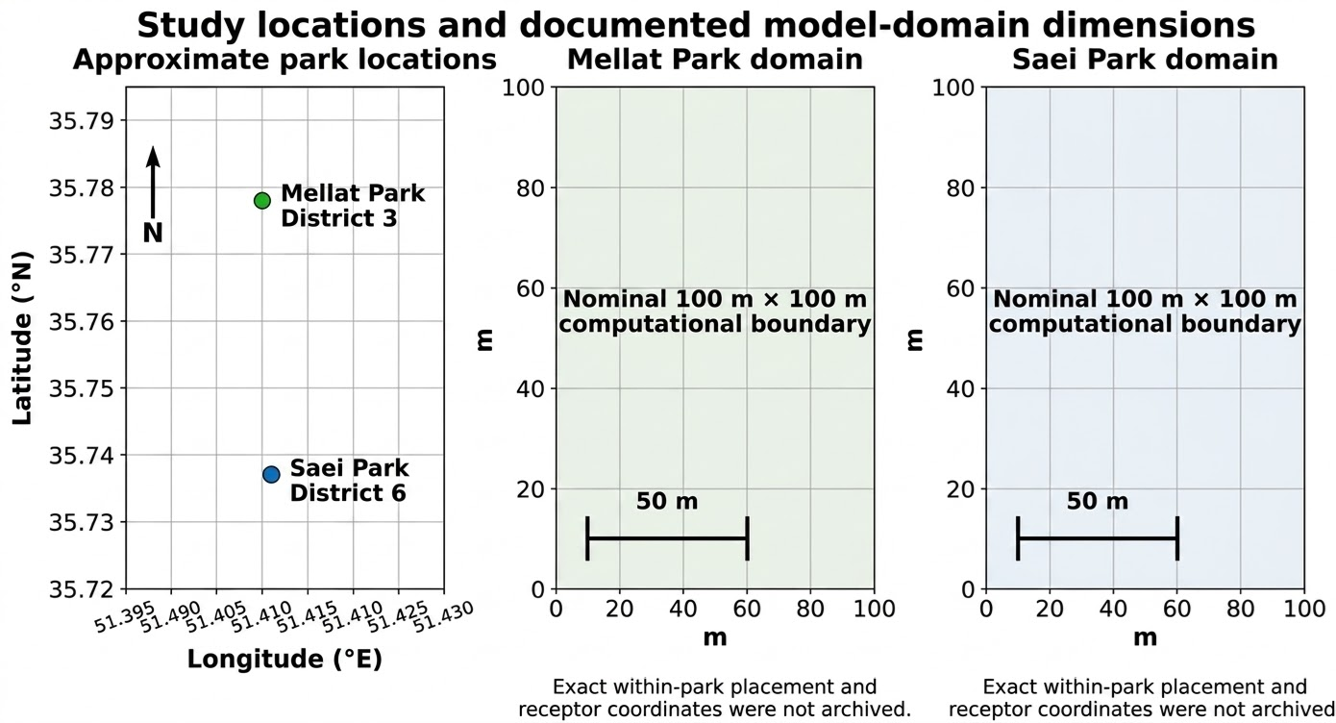
Table 2 compares the principal geographical and physical characteristics of Mellat and Saei Parks.Mellat Park is larger, located in northern Tehran’s District 3, and approximately 188 m higher than Saei Park. Saei Park is a smaller and more compact green space situated within the central urban fabric of District 6. Despite these differences, both parks were represented using comparable 100 m \(\mathrm{\times}\) 100 m computational domains.
| Characteristic | Mellat Park | Saei Park |
|---|---|---|
| Administrative district | District 3 | District 6 |
| Approximate central coordinates | 35.77804\(\mathrm{{}^\circ}\) N, 51.41002\(\mathrm{{}^\circ}\) E | 35.73658\(\mathrm{{}^\circ}\) N, 51.41122\(\mathrm{{}^\circ}\) E |
| Approximate total area | 34 ha | 12 ha |
| Approximate elevation | 1,526 m above sea level | 1,338 m above sea level |
| General setting | Large northern Tehran park | Compact central Tehran park |
| Model representation | Representative 100 m \(\mathrm{\times}\) 100 m domain | Representative 100 m \(\mathrm{\times}\) 100 m domain |
ENVI-met version 5.5 was used. Each model comprised 100 \(\mathrm{\times}\) 100 \(\mathrm{\times}\) 30 grid cells with a horizontal cell size of 1 m. Park surfaces, vegetation, paths, and relevant built edges were represented in the area-input model. The archive does not preserve the receptor count, receptor height, receptor coordinates, or the distribution of shaded and sun-exposed receptor positions. Accordingly, receptor-specific statistics cannot be reconstructed and the manuscript does not infer missing spatial information.
The same retained seasonal forcing was associated with both domains. Available forcing variables are listed in Table 3. Wind direction, sky condition, simulation date, start time, total duration, output interval, and spin-up period were not preserved. No values were inferred from regional climatology or inserted as assumptions because doing so would not reproduce the original simulations. The absence of calendar dates also prevents exact reconstruction of solar geometry.
| Condition | Air temperature (\(\boldsymbol{\mathrm{{}^\circ}}\)C) | Relative humidity (%) | Wind speed (m/s) | Solar radiation (W/m²) |
|---|---|---|---|---|
| Warm season | 35 | 40 | 1.2 | 650 |
| Cool season | 20 | 50 | 0.9 | 400 |
Table 4 summarizes the availability of the simulation and BIO-met metadata required to interpret and reproduce the PET results. Only one PET value per season and configuration was retained, while its spatial and temporal aggregation method was not documented. Receptor characteristics, personal BIO-met inputs, simulation timing, wind direction, and sky conditions were unavailable. Consequently, the results are interpreted only as configuration-level summaries and cannot support receptor-level comparisons, local comfort classification, or exact reproduction.
| Parameter | Status in retained archive | Interpretive consequence |
|---|---|---|
| PET summary type | One value per season and configuration; aggregation method not recorded | Treated only as a configuration-level summary. |
| Receptor count, height, and coordinates | Not retained | No receptor-level or pedestrian-height comparison is claimed. |
| Metabolic rate/activity | Not retained | PET values cannot be reproduced from the archive. |
| Clothing insulation | Not retained | No local comfort category is assigned. |
| Human height, weight, age, and sex | Not retained | Personal BIO-met assumptions remain unknown. |
| Simulation date and start time | Not retained | Solar geometry and exact temporal context are unknown. |
| Simulation duration and spin-up | Not retained | The values cannot be classified as instantaneous, peak, or time-averaged. |
| Wind direction and sky condition | Not retained | Boundary-condition reproducibility is limited. |
Four complete surface-canopy configurations were compared (Table 5). The baseline combined asphalt with no tree canopy. The three vegetated scenarios varied nominal reflectance, LAD, species label, and crown form simultaneously. The archive records a single nominal albedo value for each scenario but does not preserve the exact ENVI-met database field used for that value. In the ENVI-met vegetation model, leaf optical properties and LAD are represented as distinct plant characteristics; however, the retained archive does not establish whether the reported albedo values represent leaf reflectance, underlying surface albedo, or another optical input. They are therefore retained only as descriptive scenario identifiers and are not interpreted as mechanistic coefficients.
| Scenario | Recorded nominal albedo | Recorded nominal LAD (m²/m³) | Archived representation | Interpretive scope |
|---|---|---|---|---|
| Baseline (no trees) | 0.1 | – | Asphalt surface without tree canopy | Reference configuration |
| Dark-green dense | 0.2 | 1.5 | Plane-tree label; dense canopy | Bundled configuration |
| Light-green sparse | 0.4 | 0.5 | Acacia label; sparse canopy | Bundled configuration |
| Yellow/red vertical | 0.3 | 1.0 | Ornamental label; vertical form | Bundled configuration |
LAD is the leaf surface area per unit canopy volume and is normally represented as a vertical profile in ENVI-met [9]. The archive contains only a nominal LAD value and general species/crown labels. Plant-database identifiers, tree height, crown width, trunk height, vertical LAD profile, seasonal foliage state, and irrigation settings were not preserved. Because multiple attributes changed together, the analysis compares complete configurations and cannot estimate the independent effect of any single trait.
PET was obtained through the ENVI-met/BIO-met workflow, which applies a human energy-balance model to meteorological and radiative conditions [19,20]. The original PET values were retained without recalculation because the personal and temporal settings required for reproduction are unavailable. The analysis uses absolute PET and the absolute difference from the no-tree baseline:
A positive \(\Delta\)PET indicates a lower modeled PET than the baseline. Percentage changes were not calculated because PET is a temperature-based index without a physically meaningful zero for ratio comparisons. No inferential statistics were performed because only one consolidated value is available for each season and configuration.
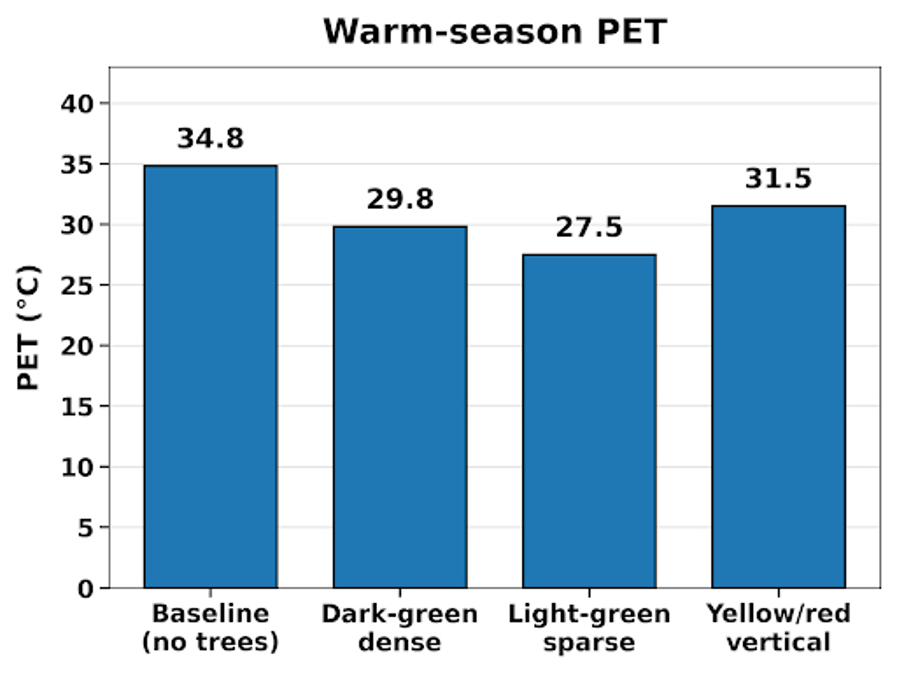
Under the retained warm-season condition, the no-tree asphalt baseline had a PET of 34.8 \(\mathrm{{}^\circ}\)C (Table 6). The dark-green dense configuration produced 29.8 \(\mathrm{{}^\circ}\)C (\(\Delta\)PET = 5.0 \(\mathrm{{}^\circ}\)C), the light-green sparse configuration produced 27.5 \(\mathrm{{}^\circ}\)C (\(\Delta\)PET = 7.3 \(\mathrm{{}^\circ}\)C), and the yellow/red vertical configuration produced 31.5 \(\mathrm{{}^\circ}\)C (\(\Delta\)PET = 3.3 \(\mathrm{{}^\circ}\)C). Under the reported conditions, the light-green sparse configuration had the lowest numerical PET; this ranking describes the complete configuration and does not isolate albedo, LAD, species, or crown form.
| Scenario | Warm PET (\(\boldsymbol{\mathrm{{}^\circ}}\)C) | Warm \(\boldsymbol{\Delta}\)PET (\(\boldsymbol{\mathrm{{}^\circ}}\)C) | Cool PET (\(\boldsymbol{\mathrm{{}^\circ}}\)C) | Cool \(\boldsymbol{\Delta}\)PET (\(\boldsymbol{\mathrm{{}^\circ}}\)C) |
|---|---|---|---|---|
| Baseline (no trees) | 34.8 | 0.0 | 13.0 | 0.0 |
| Dark-green dense | 29.8 | 5.0 | 9.8 | 3.2 |
| Light-green sparse | 27.5 | 7.3 | 8.5 | 4.5 |
| Yellow/red vertical | 31.5 | 3.3 | 11.0 | 2.0 |
Figure 2 compares warm-season PET across the baseline and three vegetated configurations.The no-tree baseline produced the highest PET at 34.8 \(\mathrm{{}^\circ}\)C. The light-green sparse configuration produced the lowest PET at 27.5 \(\mathrm{{}^\circ}\)C, followed by dark-green dense at 29.8 \(\mathrm{{}^\circ}\)C. These results describe complete configurations and should not be attributed independently to canopy colour, LAD, species, or geometry.
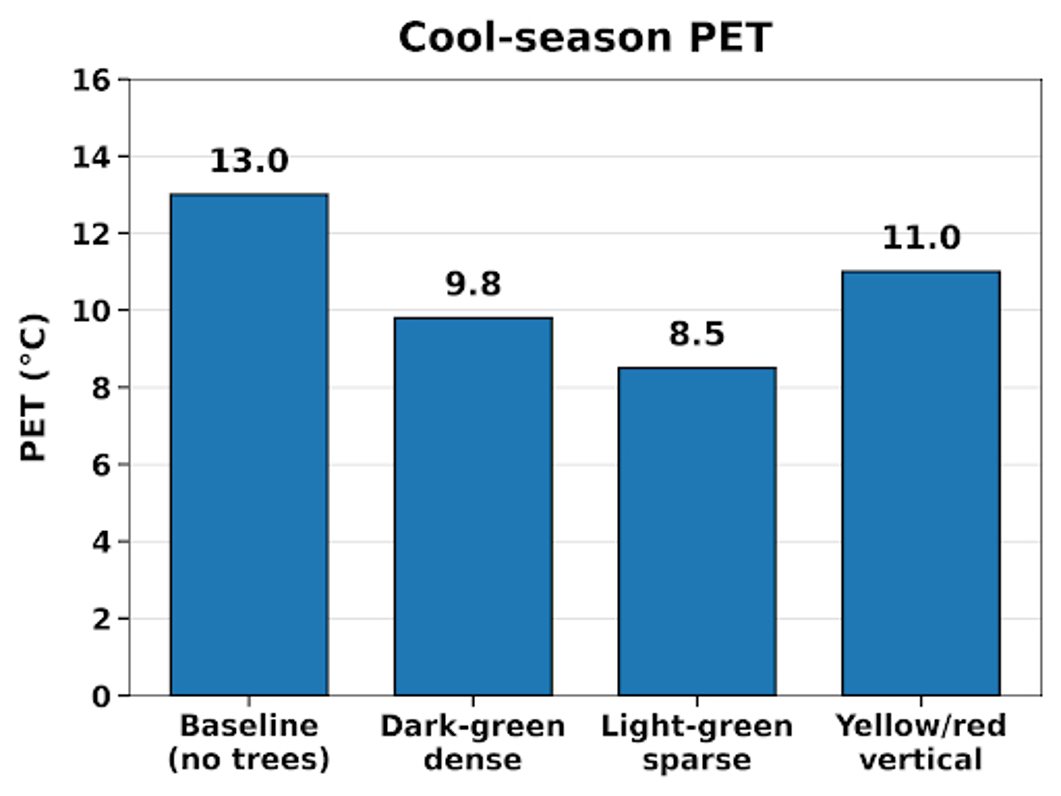
As shown in Figure 3, under the retained cool-season condition, the baseline PET was 13.0 \(\mathrm{{}^\circ}\)C. The dark-green dense, light-green sparse, and yellow/red vertical configurations produced 9.8, 8.5, and 11.0 \(\mathrm{{}^\circ}\)C, respectively. All three configurations therefore lowered PET relative to the baseline. These decreases should not automatically be interpreted as improved comfort. Tehran field studies demonstrate seasonal adaptation and differences between generic PET classifications and locally observed sensation [21,22,23], while the personal BIO-met settings used for the present values are unknown.
The warm-season reductions of 3.3–7.3 \(\mathrm{{}^\circ}\)C are directionally consistent with ENVI-met studies showing that tree configuration, foliage density, and crown geometry can reduce pedestrian thermal exposure and PET. The magnitude is within the broad range reported in ENVI-met applications, but direct numerical comparison is limited because prior studies differ in climate, validation, crown structure, forcing, receptor height, and personal settings. The results are therefore appropriate for preliminary design screening but not for site-specific prediction.
The light-green sparse configuration produced the lowest warm-season PET in the retained summary. This does not demonstrate an independent benefit of higher reflectance or lower LAD. Morakinyo and Lam [24] showed that LAI, vertical LAD distribution, planting pattern, and wind condition can interact, while Simon et al. [9] emphasized the role of detailed crown geometry and radiation transfer. A causal analysis would require a factorial simulation matrix in which one attribute is changed while all others are held constant.
For warm-season planning, the results support testing canopy configurations that provide shade at occupied pedestrian locations while maintaining ventilation. During the cool season, further PET reduction may be undesirable in some locations or times. Seasonal planting design should therefore consider deciduous behavior, path and seating locations, solar access, and ventilation together. Because the current archive lacks park-specific receptor maps, these implications are general and should not be used to prescribe a particular species or layout for Mellat Park or Saei Park.
Future work should reconstruct the complete ENVI-met area-input and configuration files, document all meteorological and BIO-met settings, validate air temperature and mean radiant temperature against field measurements, and report hourly PET at clearly mapped receptors for each park. A factorial design should then isolate crown geometry, LAD/LAI, optical properties, species representation, and planting arrangement.
The three complete vegetated configurations produced lower warm-season PET than the no-tree asphalt baseline, with absolute reductions of 3.3–7.3 \(\mathrm{{}^\circ}\)C. The same configurations also lowered cool-season PET. Because the archive contains only one consolidated value per season and configuration, no inter-park, receptor-level, spatial, or temporal comparison is claimed. Missing BIO-met settings and plant geometry prevent exact reproduction and local comfort classification.
The findings support the use of tree-canopy scenarios as an early design-screening tool, but they do not establish the independent effect of albedo, LAD, species, or crown form. For Tehran, canopy design should balance useful warm-season shade with ventilation and cool-season solar access. The next step is a field-validated, fully documented, park-specific factorial simulation.
All authors contributed equally to the conception, development, analysis, and preparation of the manuscript. All authors reviewed and approved the final version of the manuscript.
This study is based on the first author’s doctoral dissertation conducted at Tarbiat Modares University under the supervision of Dr. Afsaneh Zarkesh. The authors gratefully acknowledge Dr. Ester Higueras García of the Polytechnic University of Madrid, Spain, for her valuable support and academic assistance during the visiting research period. The authors also extend their sincere appreciation to Dr. Mohammadjavad Mahdavinejad and Dr. Kianoush Suzanchi for their insightful guidance, constructive feedback, and scholarly advice throughout the course of this research.
This research received no external funding.
Not applicable. This study did not involve surveys, questionnaires, interviews, experiments involving human participants, or the collection or analysis of human-participant data.
The scenario-level PET values used in this analysis are presented in Table 6. The complete ENVI-met input files and receptor-level output files are not available in the retained research archive.
The authors declare that they have no competing interests.