

The intensification of global climate change poses an increasingly severe threat to sustainable urban development. This threat is reflected in more frequent extreme weather events, worsening air pollution, and recurrent urban waterlogging [1]. These climate-related hazards disrupt urban production and residents’ daily lives and undermine the long-term stability of urban ecosystems [2]. To mitigate climate-related risks and strengthen urban resilience, governments increased investment in urban infrastructure, including transport systems, drainage networks, and urban parks [3]. Conventionally, these infrastructures are categorized into three distinct types: blue, green, and grey, as shown in Figure 1.
Grey infrastructure provides the material foundation for urban production and everyday life [4]. Early urban development relied heavily on concrete- and steel-based grey infrastructure for drainage, transport, and energy transmission. Although such systems are efficient in delivering specific functions, their static and rigid designs limit their capacity to adapt to climate-change uncertainties [5]. They also act as major carbon sources throughout their life cycles. In China, carbon emissions from infrastructure construction reached 980 million tons of CO\(_2\) in 2022 [6]. In addition, municipal environmental facilities, particularly wastewater treatment plants and solid waste treatment systems, have become important sources of urban greenhouse gas emissions because of their energy demand, process-related CH\(_4\) and N\(_2\)O release, and waste-management operations [7]. Roads, bridges, and pipeline networks also depend heavily on carbon intensive materials such as concrete and cement, making grey infrastructure a major source of urban carbon emissions [8].
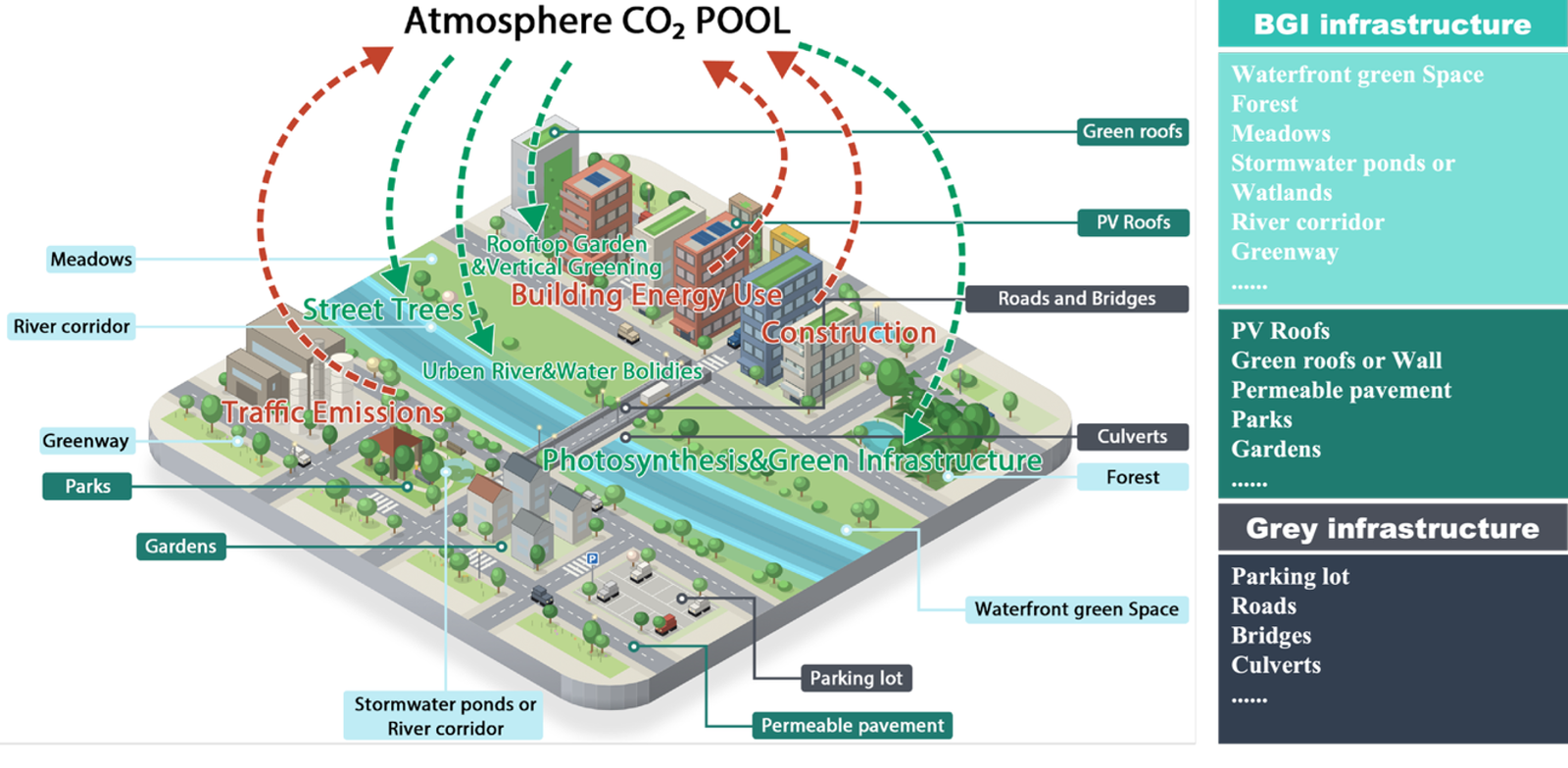
In contrast, blue-green infrastructure (BGI) offers important ecological and environmental benefits. BGI consists of interconnected natural, semi-natural, and artificial ecosystems that integrate blue and green measures to provide hydrological regulation, flood protection, and broader environmental benefits [9]. Green Infrastructure refers to ecological networks formed by urban vegetation, including parks, urban forests, and green roofs. Blue infrastructure includes urban water systems such as rivers, lakes, wetlands, artificial ponds, and canals. Beyond their established roles in hydrological regulation, urban heat island mitigation, and biodiversity conservation [10], nature-based solutions (NbS) that incorporate blue-green elements can enhance climate resilience [11]. These systems directly sequester carbon through plant photosynthesis and soil carbon accumulation [12]. They can also generate indirect emission-reduction benefits by regulating local microclimates and encouraging low-carbon behaviors [13].
Rapid urbanization has expanded construction land at the expense of ecological land, reducing carbon storage and intensifying the urban heat island effect. Stand-alone grey infrastructure is therefore increasingly insufficient for addressing climate-change challenges. Integrated blue-green-grey infrastructure (BGGI) has consequently been proposed to combine grey engineering with NbS. This integrated approach offers a framework for urban ecological governance and low-carbon development, while also providing a basis for examining how infrastructure systems can jointly support resilience and carbon reduction.
In 2012, China formally introduced the sponge city concept as a new generation of urban stormwater-management strategy. By coordinating urban drainage systems with BGI elements, this approach aims to manage flood risks and improve environmental performance [14]. Importantly, the sponge city framework brought blue, green, and grey infrastructure into a unified planning logic, thereby providing a basis for their integrated development. Early applications of BGGI multifunctionality focused mainly on urban hydrological regulation, including stormwater management and pollution prevention [15]. More recent studies have extended this focus to urban climate adaptation, particularly improvements in land-surface-temperature cooling effect and mitigation of urban thermal environments in coastal and high-density cities [16].
With the advancement of global carbon-reduction goals under the Paris Agreement, the synergistic carbon-mitigation potential of BGGI has attracted increasing attention. However, the transition towards low-carbon infrastructure depends not only on technical performance but also on policy instruments, financial conditions, and local institutional capacity. For example, green-finance reforms promote urban carbon reduction, although their effects vary across cities [17]. Within this broader enabling context, BGGI provides a potential technical pathway for improving urban resilience and climate adaptability under carbon-neutrality targets. Existing research has mainly developed along two lines: enhancing carbon sequestration in blue-green spaces and promoting the green retrofitting and low-carbon upgrading of grey infrastructure.
For blue-green spaces, studies have reported their carbon-sequestration and emission-reduction potential through field measurements, remote-sensing inversion, and numerical modelling. Urban forest vegetation is widely regarded as a key carbon sink and plays an important role in strengthening the carbon-sequestration capacity of urban ecosystems [18]. Chen et al. quantified the climate-regulation function of 1,510 urban parks in the Yangtze River Economic Belt, China, and estimated that these parks could cumulatively save 23.7 \(\mathrm{\pm}\) 1.6 tons of carbon dioxide while alleviating summer heat stress [19]. Similarly, Jiang et al. examined the carbon-sequestration capacity of urban blue-green spaces and explored how park spatial morphology affects this capacity using ENVI-met and boosted regression tree models [20]. Wang et al. further proposed a mathematical framework for evaluating the synergistic benefits of blue-green-grey systems, including energy conservation, carbon offsetting, and human health benefits [21].
Grey infrastructure has also become an important focus in urban low-carbon transformation. As global urbanization shifts towards more ecological forms of development, the spatial planning of grey infrastructure and the enhancement of ecosystem services are increasingly viewed as key priorities for carbon reduction [22]. Integrated green-grey infrastructure has been recognized as an effective approach for addressing climate-related urban challenges, including waterlogging, intensified heat-island effects, and high carbon emissions [23]. Among these strategies, green roofs represent a typical grey-to-green retrofitting measure and have become a major research focus. Yang et al. reported that rooftop greening in large cities has substantial carbon-sequestration potential and could offset a considerable share of household carbon emissions [24]. Lugo-Arroyo et al. also examined the ecological functions of vegetated building roofs and reported their contributions to carbon sequestration and summer cooling [25].
Innovative and permeable pavements provide another pathway for the low-carbon retrofitting of urban roads. Fang et al. reviewed the design, application, and performance of ecological permeable pavement materials (Eco-PPMs), and summarized evidence suggesting their potential to mitigate urban heat and improve climate adaptability [26]. Several life-cycle assessments have estimated that permeable pavements may have lower environmental impacts than conventional pavements under the adopted assessment conditions [27].
Overall, the integrated development of blue, green, and grey infrastructure has become an important direction for urban low-carbon transformation. Existing studies have examined the ecological benefits of blue-green spaces and the low-carbon retrofitting of grey infrastructure. However, most research still focuses on individual infrastructure elements, with limited systematic assessment of the overall carbon-saving benefits of integrated BGGI systems. These studies provide important evidence on the functions of individual infrastructure components. However, the overall carbon performance of BGGI depends not only on the separate effects of blue, green, and grey infrastructure, but also on their functional, spatial, and life-cycle interactions. The integration of these components may create additional benefits through carbon sequestration, microclimate regulation, hydrological management, and low-carbon infrastructure transformation, but these benefits may also involve trade-offs related to embodied carbon, land use, water demand, maintenance, and economic cost. Therefore, the system-level synergies and trade-offs of BGGI require further synthesis.
This review examines the evolution of urban BGGI research, its carbon-reduction pathways and heat-resilience effects, the analytical approaches used, and the limitations of current assessment frameworks. It covers individual infrastructure elements and coupled configurations across urban scales, while distinguishing component-level findings from integrated-system assessments. Specifically, it addresses three questions: (1) How has urban BGGI research evolved, and what major themes and geographical contexts characterize the evidence base? (2) How do blue–green components and grey-infrastructure design and retrofitting contribute to carbon reduction and heat resilience, and how are these effects assessed? (3) What methodological, spatiotemporal, and life-cycle limitations constrain current assessments, and how can future research improve BGGI evaluation and planning?
The remainder of this review is organized as follows. Section 2 describes the literature retrieval process and review methods. It then examines publication and citation trends, traces the evolution of major research themes, and presenting the conceptual framework for evidence synthesis. Section 3 classifies the reviewed analytical approaches according to their roles within this framework and discusses their applicability and methodological boundaries. Section 4 synthesizes the main carbon-reduction pathways of BGGI. Section 5 discusses limitations in current assessment frameworks, spatial and temporal comparability, and life-cycle carbon accounting, and identifies priorities for future research. Section 6 presents the conclusions.
This study adopted a narrative review approach to examine the mechanisms, assessment methods, and implementation challenges associated with blue–green–grey infrastructure (BGGI) for urban carbon reduction and heat resilience. The scope of literature retrieval and screening is limited to the web of science core collection and ScienceDirect databases. Editions mainly come from Science Citation Index Expanded (SCI-EXPANDED), Social Sciences Citation Index (SSCI), and Arts & Humanities Citation Index (A&HCI). The language of the article was restricted to English. To ensure the timeliness and coverage of the research, the publication period of the literature is set from January 1, 2000, to December 1, 2025. For articles that were available online before 1 December 2025 but were subsequently assigned to a journal volume or issue published in 2026, the date of first online publication was used to determine eligibility. Thus, some references with the year of publication 2026 were also included in this review.
First, in the Web of Science Core Collection, the advanced search function was used to identify the literature by setting keywords. The theme was set as TS=(Carbon) AND TS= (Infrastructure OR Space OR Planning) AND TS= (GBGI OR BGGI OR BGI OR blue-green OR green-gray OR Green-blue OR Gray infrastructure Retrofit) NOT TS=(Hydrogen) NOT TS=(Algae). To account for spelling differences between American and British English, both variants of the relevant terms, including “green-gray” or “green-grey” and “gray infrastructure retrofit” or “grey infrastructure retrofit,” were included in the Web of Science searches. The inclusion of both spelling variants did not change the final set of eligible records. For terminological consistency, the British spelling “grey” is used throughout the main text. This search yielded 96 records.
Because recently published articles may not yet have been indexed in the Web of Science Core Collection, the same core concepts were additionally searched in ScienceDirect, with the search syntax adapted to the ScienceDirect interface. This supplementary search identified five additional records, which were combined with the Web of Science results, yielding 101 records for title-and-abstract screening.
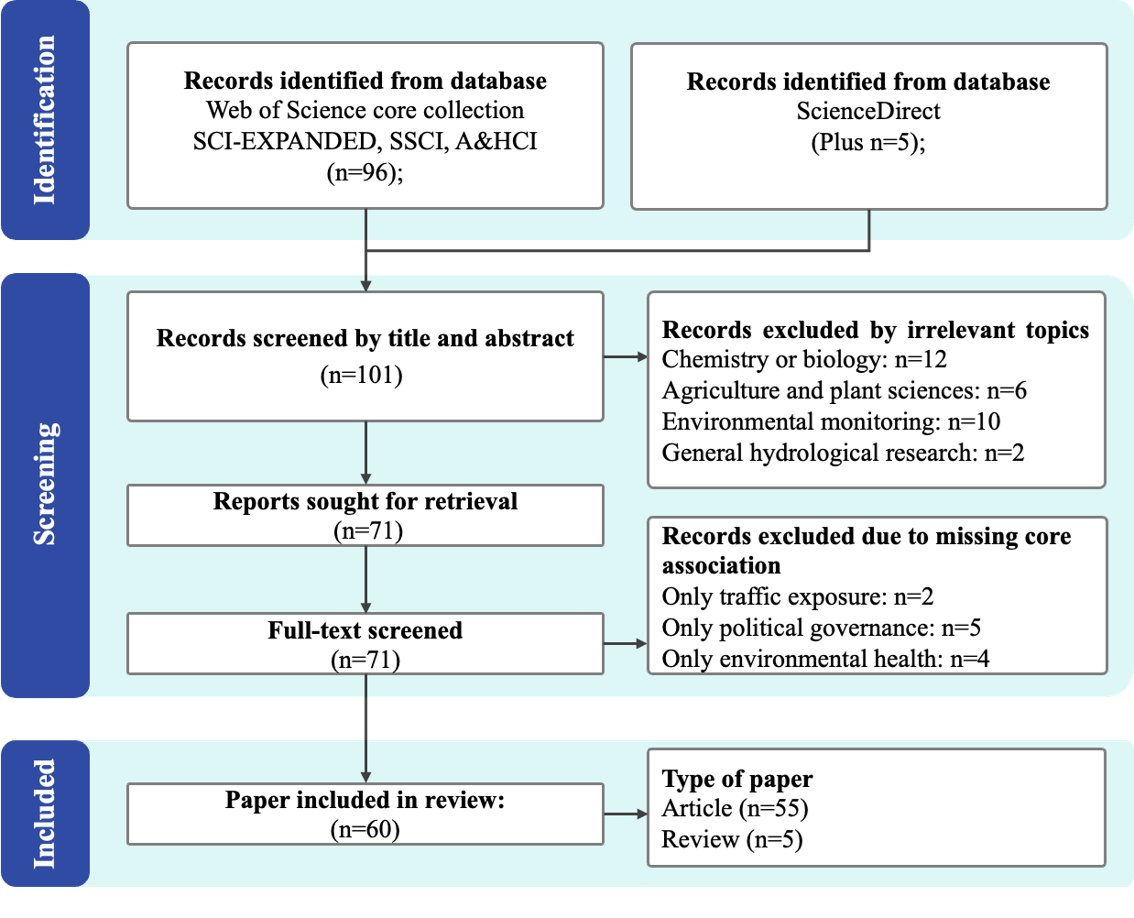
Secondly, the research field filtering and title-and-abstract screening functions were used to process the collection of papers. A series of unrelated topics, including chemistry or biology (n = 12), agriculture and plant sciences (n = 6), environmental monitoring (n = 10), and general hydrological research (n = 2), were excluded. After this stage, 71 reports were sought for retrieval, and the full texts of all 71 reports were screened. Based on this, the articles were manually screened, mainly to eliminate those with a weaker connection to research core association, as well as some articles focusing only on traffic exposure, political governance, or environmental health. Eventually, a core collection of 60 papers was obtained. Among them, there are 55 original research articles and 5 review articles. The original research articles formed the main empirical basis of the review, whereas the review articles were used as contextual and conceptual sources to trace terminology, research development, and methodological debates. They were not treated as independent empirical observations. The specific search and filtering process is detailed in Figure 2.
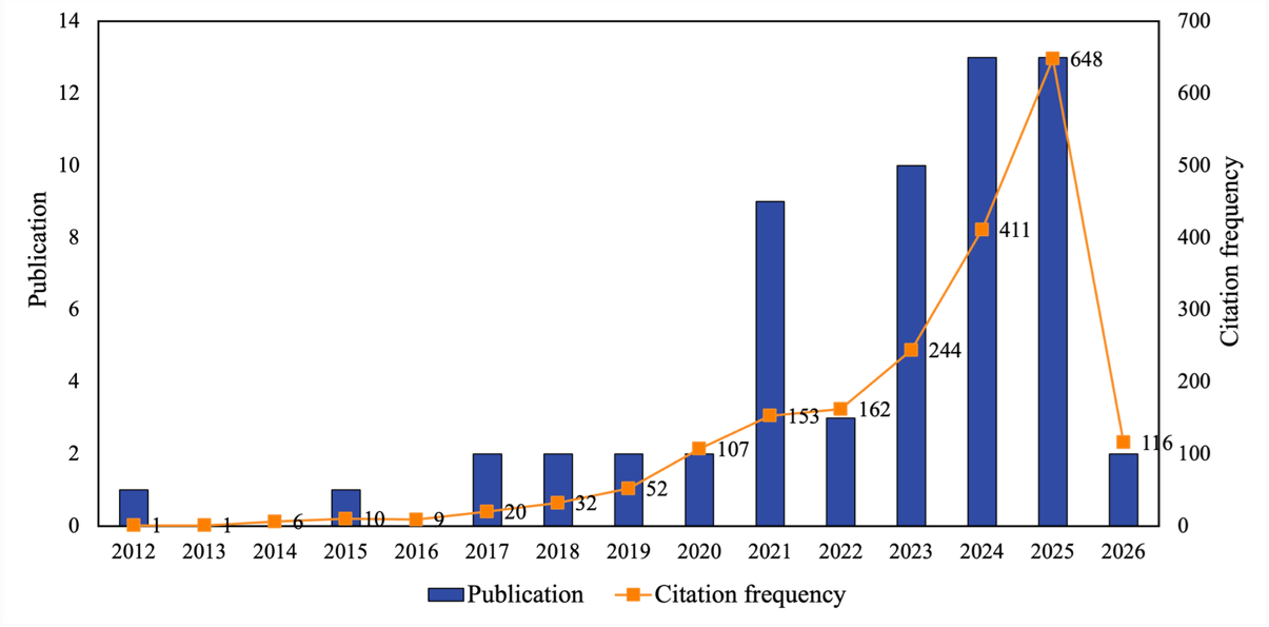
As shown in Figure 3, the study analyzed the publication trends of the literature collection. With the carbon reduction activities across the entire industry, research on blue, green and grey infrastructure and carbon mechanisms has gradually becomes a hot topic. The total citation count of the paper is 1,972, with an average of 371.36 citations per year. The research shows a distinct recent aggregation feature, with the proportion of literature from 2023 to 2025 reaching 60.0%, reflecting the activity and development trend of research in this field. This pattern indicates growing scholarly attention to infrastructure integration and carbon-reduction benefits.
Secondly, an in-depth analysis was conducted on the spatial distribution trend of the research. The 55 research articles were from 14 different countries and regions. Most of the studies originated from China (61.8%), followed by Europe (21.8%) and the United States (7.2%). A few other studies were from Australia, Ethiopia, India and Brazil (each accounting for 1.8%). The core themes of BGGI research also vary from region to region. Studies in the Chinese region mostly focus on typical cities in the temperate and subtropical monsoon climate zones. Urban parks, waterfront green spaces and urban blue-green landscape patterns are the most common types of research to address urban overheating and reduce carbon emissions [28]. In studies in the European region, green roofs are the most frequently studied intervention to enhance ecosystem services [25,29], other types include urban ponds, water bodies and street vegetation [30,31]; The United States mainly focuses on the hydrological regulation role and life-cycle carbon assessment of BGI [8,32].
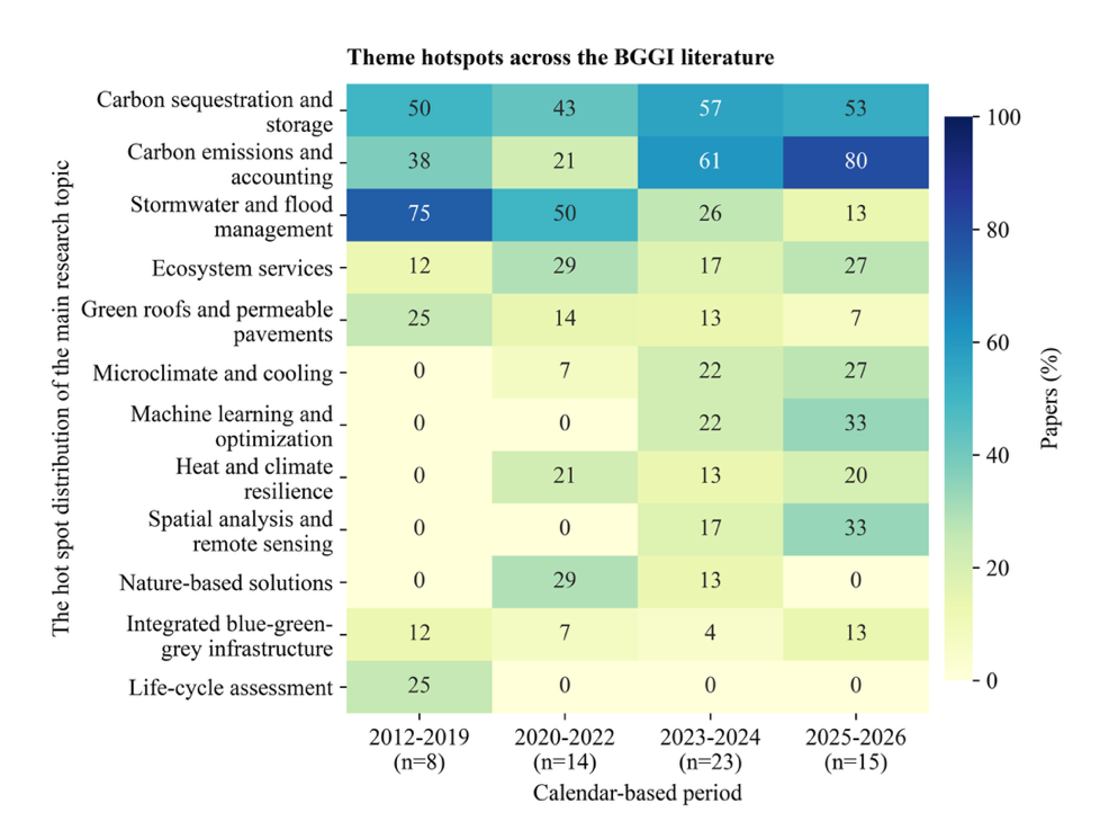
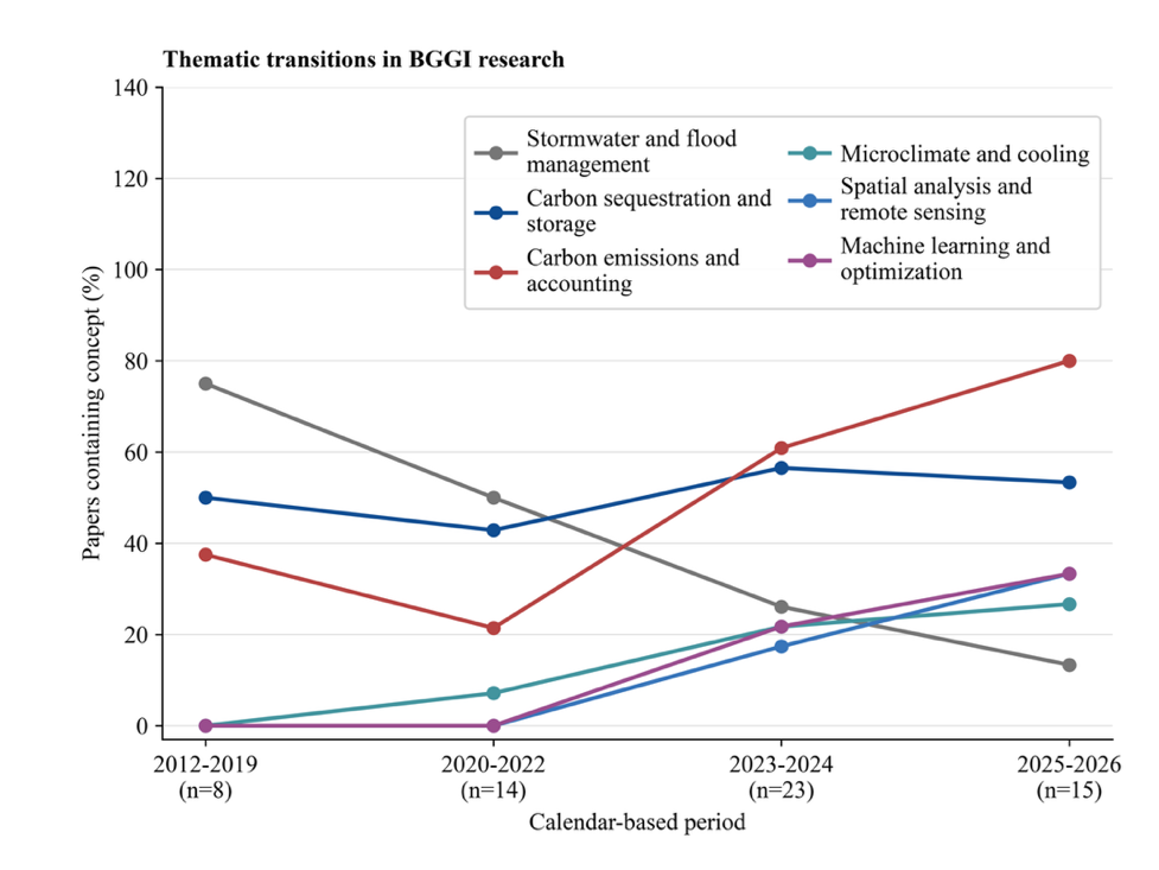
Figures 4 and 5 summarizes the temporal evolution of major research themes in the BGGI literature. The heatmap shows that early studies were strongly associated with stormwater and flood management, which appeared in 75.0% of publications from 2012–2019 but declined to 13.3% in 2025-2026. By contrast, carbon emissions and accounting increased from 37.5% in 2012-2019 to 80.0% in 2025-2026. Carbon sequestration and storage remained a persistent theme throughout the study period, appearing in approximately 43-57% of publications across the four periods. The line plot further indicates the increasing prominence of microclimate and cooling, spatial analysis and remote sensing, and machine-learning-assisted optimization after 2023. These patterns suggest a gradual shift from conventional stormwater and flood-risk management towards carbon accounting, thermal regulation, spatial analysis, and integrated optimization of urban infrastructure systems.
As shown in Table 1, for descriptive purposes, the temporal evolution of research themes was organized into four calendar-based periods according to the distribution and thematic characteristics of the collected literature, and their related topics and research cores are analyzed in general. The results suggest a transition from stormwater and flood management towards carbon accounting, spatial analysis, machine-learning-assisted modelling, microclimate regulation, and integrated infrastructure optimization.
The analysis was based on controlled concepts extracted from article titles, keywords, abstracts, etc., rather than on a formal keyword co-occurrence change-point analysis. Because publication volume was unevenly distributed across periods, 60% of publications were published between 2023 and 2025. Therefore, Stages 3 and 4 are supported by a larger and more heterogeneous literature base than Stages 1 and 2. The observed differences in thematic prevalence should be interpreted as indicative patterns rather than definitive temporal breakpoints.
Stage 1 focused mainly on urban hydrological management and basic disaster prevention. Representative keywords included centralized stormwater drainage, flood-control measures, and economic-benefit assessment of stormwater systems, etc. Research during this period explored how traditional grey infrastructure could be combined with blue-green facilities to reduce stormwater and flood risks while generating additional ecological benefits [33]. Notably, F. Li et al. clearly defined urban ecological infrastructure and proposed an integrated blue-green-grey framework, offering an important perspective for sustainable urban development under climate-change pressures [34]. This stage laid the theoretical and practical foundation for the coordinated use of blue, green, and grey infrastructure in stormwater management, flood prevention, and disaster-risk reduction.
As global climate change intensified, BGGI research gradually shifted from conventional stormwater management towards broader objectives, including extreme-weather adaptation and ecosystem-service enhancement. In Stage 2, keyword clusters expanded to include NbS, urban heat island effects, and climate resilience. Studies paid increasing attention to the multiple ecological functions of blue-green spaces, including urban heat-island mitigation, microclimate regulation, climate-adaptation enhancement, and improvement of residents’ thermal comfort [21,26]. Research also extended into social dimensions by examining equity and environmental justice in the distribution of ecosystem services across urban neighborhoods [12]. This stage broadened the scope of BGGI research and promoted a thematic transition from single-purpose stormwater control to the integrated consideration of climate adaptation and social equity.
| Stage | Keywords | Research topics |
|---|---|---|
| Stage1: 2012-2019 | Sustainable drainage systems; blue-green cities; flood risk management; synergy benefits; low-impact development | This stage focused on stormwater drainage, flood mitigation, and multifunctional drainage design. It explored the integration of traditional grey infrastructure with BGI to reduce urban flood risk and generate additional ecological benefits. |
| Stage2: 2020-2022 | NbS; urban heat island; ecosystem services; climate resilience; allocation equity; eco-permeable pavement | This stage examined the role of NbS in mitigating urban heat-island effects, regulating urban microclimates, improving residents’ thermal comfort, and enhancing the equitable distribution of ecosystem services. |
| Stage3: 2023-2024 | Carbon-sequestration and carbon saving potential; local climate zones (LCZ); food-water-energy nexus; XGBoost-SHAP model; net primary productivity (NPP) | Research highlights the direct carbon-sequestration benefits and indirect carbon-reduction potential of blue-green spaces. Machine-learning and algorithm models were increasingly used to quantify relationships between landscape spatial patterns, carbon-sink capacity, and thermal regulation. |
| Stage4: 2025-2026 | Carbon balance; synergistic effects; block morphology; multi-objective optimization; spatiotemporal dynamics, cold-island network | This stage emphasizes multi-objective collaborative optimization, spatiotemporal dynamic analysis, and low-carbon planning strategies for integrated urban infrastructure systems. |
Stage 3 corresponded to the accelerated promotion of global carbon-neutrality goals. During this period, the research focus shifted further towards low-carbon transformation, with particular attention to the identification and quantification of carbon-sink benefits in blue-green spaces [19]. Machine-learning methods and algorithmic models, including XGBoost and LightGBM, were increasingly applied to evaluate the nonlinear effects of complex spatial patterns on carbon reduction. These approaches helped quantify nonlinear relationships and threshold effects between blue-green landscape patterns, carbon-sink capacity, and land surface temperature (LST) [13], thereby improving the precision and explanatory power of related studies. In addition, research perspectives expanded from single BGI elements to the metabolic processes of complex urban systems. For example, X. Yan et al. used ecological network analysis to explore carbon-metabolism mechanisms coupled with dynamic changes in the food-water-energy system and BGI [35].
Recent literature suggests that Stage 4 research is becoming more practical, forward-looking, and system oriented. The research focus has moved towards multi-objective collaborative governance, spatiotemporal dynamic evolution, and ecological-resilience enhancement. Rather than pursuing single cooling or carbon-reduction targets, recent studies have increasingly emphasized the comprehensive improvement of ecological benefits [36]. The research scope has also expanded from local blue-green patches to block-form optimization, grey-green infrastructure integration, and the efficient use of underground space. Combined with predictive models, these studies analyze the spatiotemporal impacts of infrastructure systems on carbon emissions and provide scientific support for low-carbon urban planning [23,37]. Further research has deepened the construction and optimization of urban cold-island networks. By exploring future changes in carbon storage under different scenarios, scholars have proposed multi-objective optimization schemes to improve the carbon resilience of urban ecosystems under global climate change [38]. Other studies have focused on post-pandemic urban planning and environmental governance, emphasizing the importance of proactive interventions, such as blue-green spaces, in strengthening urban risk resistance and reducing carbon emissions [39]. These developments indicate that research on carbon reduction in urban ecological environments is shifting from passive disaster prevention towards active climate regulation and carbon-neutrality-oriented planning.
To provide a coherent basis for the synthesis, the reviewed evidence is organized using a five-dimensional conceptual matrix linking infrastructure configuration, causal mechanism, assessment boundary, outcome indicator, and methodological approach (shown in Table 2). Infrastructure configuration distinguishes individual blue, green, and grey components from coupled blue-green, green-grey, and integrated BGGI systems. Causal mechanisms are differentiated among direct biogenic carbon sequestration, thermal regulation with potential avoided operational emissions, and changes in embodied and operational emissions associated with grey-infrastructure design and retrofitting.
Assessment boundaries specify the spatial unit, temporal horizon, and accounting scope within which an effect is estimated. Outcome indicators are separated into carbon storage, carbon fluxes, thermal outcomes, and energy-related outcomes. Methodological approaches are classified according to their analytical roles-observation and spatial characterization, ecosystem service or process simulation, statistical attribution and prediction, and life cycle or economic evaluation rather than being treated as equivalent methods. This framework guides the discussion of methodological approaches in Section 3, the synthesis of carbon and thermal pathways in Section 4, and the assessment of evidence limitations in Section 5.
As shown in Table 2, the reviewed approaches were classified according to their different analytical functions rather than treating them as equivalent techniques. Remote sensing and geographic information systems primarily support data acquisition, spatial characterization, and change detection. InVEST, CASA, PLUS, CA-Markov, system dynamics, and ENVI-met represent different ecological, land-use, system-feedback, or microclimate processes. Regression models and machine-learning approaches are mainly used to characterize associations, spatial heterogeneity, nonlinear relationships, and predictive patterns. Life-cycle assessment and economic input–output analysis address environmental accounting, whereas life-cycle costing and cost benefit analysis provide economic and decision-support information. The analytical role and boundary of each approach are discussed below.
| Infrastructure configuration | Causal mechanism | Assessment boundary | Outcome indicators | Methodological approach and role |
|---|---|---|---|---|
| Individual blue or green components: vegetation, soils, water bodies and wetlands | Photosynthetic uptake and biomass, soil or sediment carbon accumulation; possible non-CO\(_2\) fluxes | Component, site or ecosystem; carbon storage versus annual flux; ecological or operational period | Carbon storage, carbon density, carbon sequestration rate, net primary productivity, carbon sink capacity | Field measurements for direct observations; remote sensing/GIS for spatial characterization; InVEST or CASA for spatial estimation and scenario analysis |
| Blue-green spatial configurations in the urban fabric | Shading, evapotranspiration, ventilation and water-mediated cooling; potential reduction in cooling demand | Patch, block, building, district or city; diurnal, seasonal or operational-energy boundary | LST, cooling effect, thermal comfort, building energy demand, avoided emissions | Remote sensing for LST retrieval; ENVI-met for microclimate simulation; regression/GWR and machine learning for association, prediction or attribution |
| Grey infrastructure and green-grey retrofits | Material substitution, reduced material demand, operational-energy improvement and ecological retrofitting | Infrastructure asset or project; construction, operation, maintenance, replacement and end of life | Embodied carbon, operational emissions, energy consumption, life-cycle carbon emissions | LCA or EIO for environmental accounting; LCC and CBA for economic evaluation and decision support |
| Coupled blue-green, green-grey or integrated BGGI systems | Functional coupling and trade-offs among sequestration, cooling, hydrological regulation, materials and energy use | Multi-component system under a common spatial, temporal and life-cycle boundary | Carbon balance, heat resilience hydrological performance, economic costs, synergistic benefits | Coupled scenario models, multi-objective optimization and integrated LCA-LCC-CBA assessment |
Spatial analysis and remote sensing are widely used to characterize BGGI patterns across multiple spatial scales [40]. Remote sensing primarily supports spatial data acquisition and the retrieval of surface parameters, with Landsat 8 and Sentinel imagery serving as common data sources. Geographic Information Systems (GIS) are used to integrate and analyze these data for spatial-feature identification, spatiotemporal change detection, and the characterization of blue–green infrastructure configurations [41].
At the city scale, P. Jiang et al. used remote-sensing and GIS data to explore the spatio-temporal evolution and spatial agglomeration characteristics of land use, carbon sink and carbon emissions in Wuhan from 2000 to 2020 [37]. At a broader regional scale, M. Chen et al. used Landsat 8 data and spatial-gradient analysis to examine differences in the carbon-saving potential of urban parks across 26 cities in the Yangtze River Economic Belt [19]. These applications illustrate the value of remote sensing and GIS for identifying spatial patterns and comparing locations. However, when remote-sensing variables are combined with regression, geographically weighted regression, or machine-learning models to estimate relationships or identify drivers, their inferential role belongs to statistical attribution and prediction rather than observation alone.
Model simulation methods are used to estimate ecosystem services, and explore changes under alternative land-use, infrastructure, or climate scenarios. The reviewed studies use InVEST to estimate carbon storage and other ecosystem-service outcomes, whereas CASA focuses on vegetation net primary productivity. PLUS and CA-Markov estimate land-use transitions, system dynamics models represent feedback within complex urban systems, and ENVI-met simulates local microclimate processes. These models therefore differ in their represented processes, spatial resolution, temporal horizon, and outcome indicators. Simulation-optimization frameworks have also been applied to drainage pipe network planning [42] and quantification of urban flood resistance capacity [43]. These models differ in their represented processes, input data, spatial resolution, and outcome variables.
The InVEST model is one of the most widely used ecosystem service assessment models at present [44]. It is often coupled with GIS, PLUS, or CA-Markov models to examine land use change, spatial planning and alternative development scenario. For instance, Zhou et al. adopted InVEST and PLUS to predicted the response relationship between blue, green and grey space changes and carbon storage under different future scenarios in Henan Province, China [38]. CA-Markov models estimate transitions among land-use classes and are therefore primarily suited to land-use scenario projection rather than direct process-level estimation of carbon or thermal mechanisms [45]. Related scenario approaches have also been used to evaluate changes in urban heat island patterns, urban energy conservation potential and cooling effect [46].
Other models address different processes and scales. System dynamics models represent feedback relationships and temporal changes within complex urban systems and can support scenario analysis of resource allocation, policy intervention, and infrastructure development [47]. CASA estimates vegetation net primary productivity from remote-sensing and environmental data and is therefore more closely related to vegetation carbon uptake than to total ecosystem carbon storage [48]. ENVI-met outputs require additional energy-demand and emission-factor calculations before they can be interpreted as avoided emissions. More generally, simulation results are dependent on model structure, parameter assumptions, input data, and scenario design rather than constituting direct observations.
Statistical and machine-learning approaches are used to characterize associations, spatial heterogeneity, nonlinear relationships, thresholds, and predictive patterns between BGGI configurations and carbon or thermal outcomes. Conventional approaches include multiple regression, geographically weighted regression (GWR), generalized additive models, and mediation analysis, whereas more recent studies increasingly apply XGBoost, LightGBM, Random Forest, boosted regression trees, and SHAP-based interpretation.
GWR and regression models have been used to assess spatially varying relationships between urban form, blue–green spatial patterns, carbon indicators, and thermal conditions. Hong et al. combined Landsat-8 remote sensing data, spatial interpolation simulation and GWR to examine the spatial relationship among urban morphology, carbon emissions and thermal conditions in Xiamen [16]. F. Yang et al. combined Landsat surface temperature inversion and multiple regression to estimate the carbon reduction under different blue-green space configurations in Tianjin [49]. These studies provide evidence of statistical relationships and spatial heterogeneity, but the identified associations should not automatically be interpreted as confirmed causal mechanisms.
Machine learning models are particularly useful for representing complex nonlinear relationships and interactions among landscape, urban-form, carbon, and thermal variables [50]. XGBoost and LightGBM combined with SHAP values have been used to decompose model predictions and identify variables that contribute strongly to predicted carbon-sequestration or thermal outcomes [51,52]. However, SHAP values describe contributions to a fitted model prediction and should not be interpreted as direct estimates of causal effects [53]. Random Forest models have similarly been applied to analyses of carbon storage changes and landscape patterns using remote sensing or land use data [54]. Multi-objective optimization models serve a different role: it searches for infrastructure or land-use configurations that balance competing objectives rather than identifying causal mechanisms. Existing applications include the optimization of blue-green spatial layouts [23], infrastructure allocation [55], and regional land use patterns [56].
Lifecycle and economic evaluation approaches address environmental and decision boundaries that are not captured by spatial observation or local process simulation. The reviewed literature includes evaluation approaches such as Life Cycle Assessment (LCA), Life Cycle Costing (LCC), Cost-Benefit Analysis (CBA), and Economic Input-Output analysis (EIO). These approaches are complementary but not equivalent. LCA and EIO primarily quantify environmental burdens or indirect emissions, whereas LCC and CBA evaluate economic costs, benefits, and decision feasibility [57].
LCA quantifies environmental burdens across defined life-cycle stages using indicators such as carbon emissions, energy consumption, and pollutant discharge. LCC centers on economic cost accounting, including initial construction investment, operation, maintenance expenses, and end-of-life value [58]. CBA compares monetized benefits with costs and can include carbon-reduction benefits when these are explicitly valued [59,60]. By contrast, EIO analysis uses intersectoral economic relationships to estimate indirect carbon flows between the built environment and the wider economy [61].
In practical research, these approaches are often combined to compare the environmental and economic performance of infrastructure alternatives. De Sousa et al. combined LCA and EIO analysis to compare life-cycle carbon emissions among different green-grey infrastructure strategies in the Bronx River watershed, USA [8]. Petit-Boix et al. adopted an integrated LCA-LCC framework to quantify the environmental impacts and economic costs of green-grey stormwater management infrastructure in Brazil [62]. Such coupled assessments support decision-making under a common project or life-cycle boundary, although their conclusions remain sensitive to the functional unit, infrastructure lifespan, and system boundary adopted.
The core of the coordinated development of urban blue, green and grey infrastructure lies in the organic integration of biological carbon sequestration, engineering energy conservation and carbon emission reduction measures to form a closed-loop carbon management system [21]. BGI contributes directly through carbon storage and sequestration and may contribute indirectly by regulating microclimate and building energy demand. The low-carbon transformation of grey infrastructure can further reduce embodied and operational emissions. Evidence from multi-objective infrastructure planning and catchment-scale life-cycle assessment suggests that the carbon benefits of BGGI depend on how blue, green, and grey components are spatially configured, functionally coordinated, and managed over their service lives [63].
Urban blue–green space combines blue and green elements and serves as an important carrier of carbon sequestration and a natural carbon pool. Its carbon sink mechanism mainly consists of carbon sinks in vegetation and soil systems as well as carbon sinks in water bodies and wetlands. The vegetation-soil system focuses on discussing the sequestration rates of different vegetation types and tree species diversity [64] and the accumulation patterns of soil organic carbon [65]; Water body wetlands emphasize the long-term sequestration and stable storage of carbon by aquatic plants, sediment and wetland ecosystems [31]. With the deepening of research, the integrated configuration and optimization of blue and green spatial patterns have become the key direction for improving urban carbon sink benefits. Integrating spatial structure, connectivity, and ecological functions may support a shift from isolated carbon-sink enhancement towards more coordinated improvement [66].
The carbon sink capacity of blue and green spaces not only depends on their total coverage rate but is also dynamically regulated by the characteristics of the spatial pattern. Quantifying the form of blue and green spaces and their carbon sequestration functions through landscape pattern indices is an effective approach. Specific indicators include key indicators such as plaque size, shape, connectivity, and plaque density [67].
With the urgency of sustainable development for cities to enhance their carbon sequestration capacity, comprehensive assessment frameworks have been recently studied and developed. A series of landscape metrics are widely adopted, including aggregation index [52], plaque connectivity, and contiguity index [68], fractal dimension index, and shannon diversity index [37]. These indicators enable the quantitative characterization and optimal regulation of the ecological network structure and functional attributes of blue-green elements. Li et al. found that there is a binary relationship between Shannon diversity index and carbon density, indicating that there is a potential carbon density regulation threshold in the blue-green space network [69]. Yuan et al. found in their study on the carbon sequestration benefits of the blue-green landscape pattern in the central urban area of Nanjing that the higher the aggregation, adjacency and connectivity of the blue-green patches, the better the carbon sequestration effect [13].
It is worth mentioning that in relevant studies in China, the hydrological functions, pattern evolution and carbon benefits responses of blue-green spaces in megacities and high-density urban areas have become key topics [67]. Jiang et al. selected six landscape indicators such as the area-MN, aggregation index, and COHESION, and analyzed the coupling relationship among land use mix, landscape characteristics, and carbon balance [37]. Shou et al. reported significant associations between patch area, shape complexity, spatial connectivity, and carbon-sequestration benefits across five high-density cities in the middle and lower reaches of the Yangtze River [51]. Cao et al. evaluated the carbon sink capacity of the forest ecosystem in Beijing and predicted the future potential [70]. Yang et al. quantified the cooling effect and carbon emission reduction differences of the blue-green space combination model in Tianjin under different seasonal conditions [71]. These findings fully verify that BGI delivers prominent carbon sequestration benefits. However, fully realizing this potential requires spatial planning to move beyond the singular pursuit of areal expansion. Instead, planning practices should root in urban fabric and systematically optimize patch quality, landscape connectivity, ecological community composition, and seasonal ecological functions.
Blue–green spaces can alleviate urban heat through evapotranspiration, providing cooling that may reduce operational emissions when it lowers building energy demand. Functional spaces such as urban parks, roadside shading, wetlands, and waterfront green corridors have been reported to provide substantial microclimate-regulation effects [72,73]. Urban parks can effectively reduce the dependence of buildings on artificial refrigeration through physical cooling and thermal mitigation effects, thereby reducing carbon emissions resulting from the consumption of fossil energy [20]. Mo et al. found through a study of 1,510 urban parks in the Yangtze River Economic Belt that their potential cooling effect could offset 5.37% of fossil fuel emissions per year [19]. Du et al. estimated that the carbon-saving potential of 65 urban parks in Xi’an could offset approximately 3.6% of metropolitan fossil-fuel emissions [74].
Furthermore, as the ecological skin of the building surface, green or blue-green roofs can provide a variety of ecological services, such as reducing rainwater runoff, improving water quality [75], lowering the building temperature, and mitigating climate change [25]. Koscikova et al. ‘s research indicates that if green roof renovations are implemented in all bus waiting halls across the city, Edinburgh could approach its carbon neutrality goal by 2030 [29]. Andrew et al. evaluated the SuDS intervention measures in the city center of Newcastle using the Benefits of SuDS Tool (BeST). The BeST assessment estimated potential noise-reduction and carbon-sequestration benefits from increasing natural surface area, including green roofs [14]. Apart from green roofs, other elements of blue and green spaces, such as small water bodies [30], urban underground space [28], waterfront green spaces [54], coastal blue carbon ecosystems [16,73], also provide important low-carbon regulation functions. These findings provide strong evidence that blue–green infrastructure can improve urban microclimates and generate substantial operational-stage carbon-reduction benefits. Nevertheless, such ecological benefits are not guaranteed. Their realization hinges on whether blue-green retrofitting schemes are tailored to site scale, regional climatic conditions sand building energy consumption characteristics. Thermal improvements resulting from local cooling and humidification cannot be equated directly with reductions in carbon emissions.
Traditional grey infrastructure including hardened roads, concrete pipe networks and impermeable pavements typically has high carbon emissions, strong heat accumulation and poor ecological performance. It emits large quantities of CO\(_2\) in construction and operation and represents a key urban carbon source [76]. Given the “dual‑carbon” goals and urban low‑carbon transition, grey‑infrastructure low‑carbon retrofitting is essential for coordinated carbon reduction of BGGI. Research to‑date concentrates on two technical routes: material innovation and functional optimization.
Material innovation reduces carbon footprint through the substitution of low-carbon building materials. Replacing traditional materials with recycled aggregates, low-carbon cement, bio-based composites, etc. may contribute to reducing infrastructure emissions [77]. Some studies have estimated carbon emission reductions of up to 90% for recycled concrete aggregates under specific material and life-cycle assumptions [78,79]. Wang et al. estimated that adding wheat-straw biochar to soil could store approximately 30 tons of carbon per hectare under the studied conditions [80].
Functional optimization combines grey infrastructure with blue-green ecological functions, organically coupling grey facilities with blue-green ecological spaces. Such integration may reduce the embodied emissions of grey facilities and partly offset remaining emissions through blue–green carbon sinks. A series of ecological renovations such as by optimizing permeable pavement of roads, building-integrated photovoltaics and grey-green balance configuration can contribute to improving the thermal comfort of the living environment and reduce the indirect carbon emissions and energy consumption of the operation of grey facilities [81,82]. These findings demonstrate that material innovation and functional optimization provide complementary pathways for the low-carbon transition of grey infrastructure. However, their net carbon benefits cannot be judged from any single stage. They must be evaluated across the full life cycle by weighing emissions from construction, operation, and maintenance against long-term carbon savings and broader ecological benefits.
The carbon benefits of the BGGI collaborative system arise from the functional complementarity of BGI and low-carbon grey infrastructure, rather than from the isolated performance of any single component. Grey infrastructure provides structural support, drainage capacity, and centralized service functions, whereas blue-green spaces provide direct carbon sequestration and indirect carbon emission reduction through microclimate regulation and reduced cooling demand. Their combination can therefore link carbon sequestration, carbon emission reduction, hydrological regulation, and heat resilience within a common infrastructure system [21]. The resulting carbon benefits depend on how these components are spatially and functionally coordinated.
This complementarity may also reduce the cost of carbon reduction through the shared use of land, construction processes, and maintenance systems. Liu et al. conducted multi-objective optimization of an integrated green-grey infrastructure in Guangzhou, China, and found that the integrated system could improve hydrological performance while reducing the carbon-emission cost by approximately 80% [23]. Similarly, an integrated LCA-LCC assessment of a rainwater-management project in São Carlos, Brazil, showed that the unit carbon-reduction cost of the integrated green-grey system was lower than that of a single grey facility [62]. But the existing examples mainly concern green-grey or other partial infrastructure combinations and should not be interpreted as direct evidence that all three components always produce superior performance.
Integrated optimization should therefore consider the combination, spatial arrangement, scale, material composition, and operation of blue, green, and grey components simultaneously. Existing studies have used simulation–optimization and multi-objective decision-making approaches to balance hydrological, environmental, and economic objectives [42,43]. LCA, LCC, and CBA can further support the comparison of alternative BGGI configurations by accounting for environmental impacts, economic costs, and carbon-reduction benefits over the infrastructure life cycle [83]. Nevertheless, current studies rarely evaluate all three infrastructure components under common spatial, temporal, and life-cycle boundaries. The system-level synergy of BGGI should therefore be interpreted cautiously when it is inferred from separate component studies rather than directly assessed through an integrated configuration.
These findings highlight the considerable potential of integrated BGGI systems to jointly deliver carbon reduction, hydrological regulation, heat resilience, and economic performance. However, such synergy cannot be assumed or inferred by simply aggregating component-level effects; it depends on coordinated design and management within consistent spatial, temporal, and life-cycle boundaries.
With increasing demand for sustainable urban development, the research focus of BGI has gradually shifted from single ecosystem services, such as hydrological regulation and thermal-environment cooling, towards the synergistic benefits of multiple ecosystem services, including climate regulation, carbon storage, and pollution purification. Current research has developed a range of assessment approaches for individual BGI functions, including carbon-sink accounting, cooling-effect assessment, hydrological management, and pollutant control [33,36,46].
However, comprehensive frameworks that integrate multiple services and functions remain limited. As a result, the systemic synergistic benefits of BGGI are still difficult to quantify. A further limitation is that the synergistic performance of BGGI is often inferred by combining separate assessments of carbon sequestration, cooling, hydrological regulation, and infrastructure emissions. Such an approach can identify potential co-benefits, but it may overlook interactions and trade-offs among these functions. In particular, the net carbon benefits of an integrated system depend on the relationship between operational energy savings, carbon sequestration, embodied carbon, maintenance inputs, and infrastructure service life. A common assessment boundary is therefore required to distinguish genuinely integrated system effects from the independent contributions of individual components.
Some studies have examined the relationship between blue-green-grey cooling effects and carbon emission reduction. F. Yang et al. conducted a dynamic analysis of the cooling and carbon-reduction functions of different blue-green spatial combinations under seasonal conditions, but did not fully consider the carbon-sequestration functions of blue and green elements [71]. Qu et al. [84] focused on the Harbin-Changchun urban agglomeration and quantified the nonlinear effects and trade-off thresholds of blue-green landscape combinations on vegetation net primary productivity and LST. Their study suggested blue–green spatial configurations that performed favorably under the adopted model and could inform spatial decision-making for urban heat-island mitigation and carbon-neutrality-oriented planning [84]. Other studies have assessed the multiple benefits of blue and green roofs. Cristiano et al. combined quantitative and qualitative analyses to evaluate roof runoff reduction and water-quality purification capacity [75]; while Koscikova and Krivtsov quantified the environmental benefits of green roofs, with particular attention to carbon sequestration and heat-island mitigation [29].
Although existing studies have begun to evaluate two or more ecosystem services simultaneously, a complete multidimensional assessment framework has not yet been established. Because long-term, large-scale observational datasets remain difficult to obtain, mainstream models such as InVEST and CASA face limitations in supporting complex coupled simulations and may not always ensure high estimation accuracy [85]. In addition, many studies simplify urban space into two-dimensional variables and do not fully consider vegetation vertical structure or the topological network characteristics of blue-green spaces [86]. These simplifications limit the accurate simulation of complex interactions among urban form, climate regulation, and carbon reduction.
Several review studies have also highlighted limitations in existing evaluation models and frameworks. Paton et al. systematically reviewed models used to assess the cooling potential, stormwater-management capacity, pollution-control function, and carbon-sequestration benefits of blue-green facilities [87]. They argued that future research should move beyond single-model limitations and develop process-based multi-model coupling systems. Such systems would enable the simultaneous simulation and optimization of multiple ecosystem services, thereby providing more effective tools for enhancing urban climate resilience.
From a spatial perspective, research on BGGI remains concentrated at the level of individual cities, specific districts, or urban parks. Although some studies have expanded to provinces and urban agglomerations, cross-city comparisons remain limited because studies differ in infrastructure type, spatial unit, outcome indicator, and assessment boundary. The existing evidence is also concentrated in large and high-density cities, leaving BGGI carbon effects in smaller cities and less-studied climate zones insufficiently understood.
Regional studies in China have examined land-use change, carbon emissions, direct carbon sequestration, and cooling effects in several provinces and urban agglomerations [38]. However, these studies generally use different data sources, spatial units, indicators, and model assumptions, which limits direct comparison.
Although research has expanded from individual cities to regional systems, cross-climate-zone comparisons of BGGI carbon benefits remain insufficient. Existing studies suggest that humid regions tend to exhibit higher blue-green carbon sink benefits because of more favorable hydrothermal conditions [88]. Similar patterns have been reported by Yuan et al. and F. Yang et al., who used carbon density, defined as the ratio of carbon storage per unit area to annual carbon sequestration, as an indicator for assessing carbon sink benefits. Their studies examined carbon sequestration rates in similar types of blue-green spaces in the central urban areas of Nanjing [13] and Tianjin [49], respectively. Because these two studies were conducted independently and were not designed for direct cross-city comparison, a rough comparison of their findings suggests that the reported carbon sink benefits of BGI in Nanjing were approximately 32% higher than that reported for Tianjin. This difference may reflect variation in methodology, study period, the operational definition of carbon density, vegetation growth cycles, precipitation, and the connectivity between water bodies and green spaces, rather than a directly validated climate-zone effect. However, the carbon benefits mechanisms of BGGI in arid and semi-humid regions are still poorly understood [89], and a complete climate-gradient response framework has not yet been established [90]. In addition, existing studies often overlook nonlinear trade-offs and threshold effects between climate regulation and carbon reduction [91]. As a result, the differentiated patterns and regulatory pathways of BGGI carbon benefits across climate zones remain unclear.
From a temporal perspective, most studies rely on summer-only observations or short-term monitoring data [20,25]. This limits their ability to capture the dynamic effects of seasonal variability, diurnal changes, and extreme climate events. Seasonal differences are particularly important because winter cooling effects may increase building heating demand and thus raise carbon emissions. Evidence from Tianjin reported that fragmented green spaces may shift from carbon sinks to carbon sources under additional winter heating demand [49]. However, most current models do not explicitly represent these seasonal transitions.
Extreme heat introduces a further temporal and scenario-related uncertainty. Although BGI may reduce heat exposure and other climate-related risks [67], the attenuation of cooling efficiency under extreme-heat conditions remains insufficiently quantified. More long-term, multi-season, and cross-climate studies are therefore needed to distinguish robust BGGI effects from context-specific results [74].
As a complex ecosystem, the synergy between blue and green spaces can contribute to urban carbon sequestration and emission reduction. However, current carbon reduction assessments often treat blue and green spaces separately, and comprehensive quantitative analyses of their role as an integrated carbon sink system remain limited. Carbon sequestration in blue-green spaces occurs mainly through carbon uptake and storage by vegetation, water bodies, and soils. Most studies have focused on vegetation photosynthesis, while paying less attention to the synergistic contributions of soil carbon storage and carbon dissolution in water bodies [35]. Evidence also suggests that coastal green spaces located at the interface between water bodies and vegetation can show higher carbon sequestration benefits [54]. However, because lateral carbon transfer and deep-water carbon burial are difficult to quantify, the carbon sequestration potential of coastal blue-carbon ecosystems is often excluded from existing accounting inventories [73].
Soil carbon sequestration is increasingly recognized as an important nature-based solution for climate change mitigation, and its storage capacity is gradually being quantified [92]. For example, Gebreyesus et al. used the i-Tree Eco model to assess soil and litter carbon storage in Hawassa Park, Ethiopia, and indicated the dominant contribution of the soil carbon pool to total carbon storage [65]. Nevertheless, methodological challenges, including urban soil sampling, spatial heterogeneity, and long-term monitoring requirements, continue to limit the assessment of long-term soil carbon sequestration [93].
In urban carbon emission accounting, existing studies and regulations have mainly constrained emissions during the operational stage. From a life cycle assessment perspective, however, the embodied carbon associated with raw-material extraction, logistics and transport, construction excavation, maintenance, and end-of-life demolition has not been fully incorporated into infrastructure carbon accounting [94]. In addition, differences in service life between green and grey infrastructure are often overlooked in practical calculations [23]. More broadly, infrastructure related carbon outcomes may also be influenced by indirect effects such as resource allocation efficiency and technological innovation [95]. This omission may lead to biased estimates of embodied carbon costs across the full infrastructure life cycle.
This review examined the carbon reduction mechanisms, methodological approaches and assessment challenges associated with BGGI in urban contexts. The reviewed literature distinguishes direct carbon storage and sequestration in blue–green components, operational emission effects mediated by microclimate regulation and energy demand, and life cycle carbon effects associated with grey infrastructure design and retrofitting. Together, these effects may improve the carbon performance and heat resilience of urban infrastructure systems. However, this improvement is conditional because the net benefits of BGGI depend on the spatial configuration, life cycle carbon emissions, maintenance requirements, resource demand, and local climatic conditions of the integrated system.
The review also shows that existing studies have developed a diverse set of assessment methods for evaluating BGGI related impacts. Spatial analysis and remote sensing support spatial characterization, while simulation and machine learning support scenario assessment and prediction. LCA and EIO analysis support environmental accounting, whereas LCC and CBA support economic evaluation. However, these methods are often applied separately, and their capacity to assess the combined carbon and resilience benefits of integrated BGGI systems remains limited.
Several assessment challenges therefore remain unresolved. First, current studies still lack multidimensional frameworks that can jointly evaluate hydrological regulation, carbon storage, thermal mitigation and pollution control within the same assessment logic. Second, most empirical evidence is concentrated in specific cities, regions or climate zones, with limited comparative analysis across climatic, spatial and seasonal contexts. Third, existing carbon accounting often focuses on operational stage benefits while giving insufficient attention to embodied carbon, maintenance processes, service life differences and end-of-life impacts. These limitations may lead to incomplete or biased estimates of the net carbon benefits of BGGI interventions.
Future research should therefore strengthen the assessment basis for BGGI by improving the integration of ecosystem service evaluation, carbon accounting and infrastructure impact assessment. More attention should be given to long-term monitoring, cross-climate-zone comparison, seasonal trade-offs between cooling and energy use, and the full range of carbon sources and sinks across blue, green and grey infrastructure elements. Such work would provide a more robust evidence base for low-carbon urban planning, environmental impact assessment and infrastructure management under climate change conditions.
All authors contributed equally to the conception, development, analysis, and preparation of the manuscript. All authors reviewed and approved the final version of the manuscript.
This work was supported by the National Natural Science Foundation of China (Grant No. 52578103) and the National Social Science Fund of China (Grant No. 24FJYB035).
The authors declare that they have no known competing financial interests or personal relationships that could have influenced the work reported in this manuscript.
The data supporting the findings of this study are available from the corresponding author upon reasonable request.
| Term | Indicator type | Meaning |
|---|---|---|
| Carbon stock | State variable | The amount of carbon held in a defined carbon pool at a specific time. |
| Carbon storage | Function or state variable | The retention of carbon in vegetation, soil, sediment, or water. When referring to a quantity at a specific time, it should be reported as carbon stock. |
| Carbon density | Normalized stock indicator | Carbon stock per unit area. |
| Carbon sequestration | Process indicator | The uptake and retention of carbon in a biological or ecological system. |
| Carbon sequestration rate | Flux indicator | The amount of carbon sequestered per unit time. |
| Net primary productivity | Biological flux indicator | The carbon fixed by vegetation after plant respiration. |
| Carbon sink capacity | Potential or functional indicator | The ability of a system to remove and retain carbon under specified conditions. |
| Avoided emissions | Potential or functional indicator | Emissions that do not occur because energy use, material use, or other emission sources are reduced. |
| Carbon offsetting | Accounting concept | The use of credited emission reductions or carbon removals to compensate for specified emissions. |
| Net carbon benefits | Net outcome indicator | Carbon benefits remaining after the specified emissions and carbon costs have been considered. |
| Embodied carbon | Life-cycle emission indicator | Emissions associated with material production, transport, construction, maintenance, replacement, and end-of-life stages included in the assessment. |
| Life-cycle carbon emissions | Life-cycle emission indicator | Total carbon emissions from the life-cycle stages included in the assessment. |
| Carbon footprint | Aggregate emission indicator | The total emissions associated with a defined activity, product, infrastructure component, or system boundary. |
| Carbon sink | System status | A system in which carbon removals exceed carbon emissions during a specified period. |
| Cooling effect | Thermal change indicator | The reduction in temperature or thermal exposure produced by an infrastructure element or configuration. |
| Heat resilience | Heat-related resilience indicator | The ability of an urban system or community to maintain or recover functions during and after heat events. |
| Climate resilience | Broad resilience indicator | The ability to absorb, adapt to, and recover from climate-related stresses or disturbances. |