

When Seoul City Hall opened in South Korea in 2013, members of the general public as well as architects raised considerable criticism, stating that it did not look or feel like a city hall. Writers at many newspapers and magazines debated the design, and the building was infamously listed as the least preferred building in modern Korean architecture in a survey conducted by one Korean newspaper [1]. Although the criticism has waned over time, this phenomenon, which shows that people have certain expectations of typicality for public building design, also calls attention to the reason for such reactions: Is it the form of the building itself or the mismatch between the building form and public expectation of it as a symbol of cultural identity?
Gaps between the aesthetic preference of experts and of laypersons regarding typicality have been well reported in the literature. Laypersons tend to favor the typical design, but experts tend to prefer the unique [2, 3]. The responses to Seoul City Hall, however, were similarly critical regardless of expertise. Then is such reaction a cultural phenomenon? If Seoul City Hall had been built in a different country, would it still have received such criticism? To understand the determinants of typicality and the relationship between typicality and aesthetic preference, an approach with a theoretical framework that takes into consideration both expertise and culture is essential.
The objective of this research was to identify what determines people’s judgment of the typicality of building design and any differences in criteria according to culture and expertise. The ultimate goal of this study was to enhance designers’ understanding of how people perceive and judge building design. A cross-cultural approach is beneficial because it can provide insight into the nature of environmental preference [4].
The theory of cultural difference in cognitive processing [5, 6] served as the theoretical framework for this research. They stated that Westerners are analytic thinkers likely to focus on shared features, grouping objects in terms of rules; by contrast, East Asians are holistic thinkers likely to focus on context, grouping objects according to the relationships among them. Westerners also tend to prefer formal reasoning based on rules and logic; East Asians prefer intuitive reasoning based on sense experience [7]. Applying these theories, one can assume that cultural difference exists in the determinants of the typicality of building design in Americans and Koreans as follows: Americans will use more formal attributes of buildings as determinants of typicality than Koreans, and Koreans will use more subjective attributes than Americans. Formal attributes are physical characteristics of a building, such as its shape, size, color, and materials; whereas subjective attributes derive from holistic impressions of the building, meaning, and evocation of emotional response. In addition, because familiarity is one factor influencing the determinants of typicality, the hypothesis is that people will consider as typical those buildings located in their own country, not those located elsewhere.
In order to achieve the goals and objectives, a cross-cultural study was conducted with four groups of participants: Korean experts, Korean nonexperts, American experts, and American nonexperts. Experts comprised practicing architects and seniors in architecture school; nonexperts were not architecture majors. Participants were asked to (a) look at and rank eight images per building type—city hall, library, and museum—based on their typicality, and (b) choose five determinants of typicality from a list of 20 formal and subjective attributes. This study was a part of a larger quest to identify the relationships among aesthetic preference, culture, and expertise.
People naturally tend to categorize objects; thus, understanding the basis and the structure of categorization is central in human perception, and the way people structure categories has interested many researchers [8]. Typicality is often used interchangeably with prototypicality in the literature, and in representing the best example conveying typicality, the term prototype is used. Although prototype or prototyping is often used in architecture field to refer to a model for digital fabrication or a system to test a concept or process [9], the original meaning has a relationship with categorization. Proto typicality denotes “mental schematic representation[s] of those features occurring most frequently in category members” [8, p. 149] and “the central tendency of the category and frequency of encounters with the object as a category member” [10, p. 82]. It is the best example that represents the category [11, 12] and the basis for category formation [13].
In architecture design, typicality can be understood with the view of a match between form and function (or the purpose) of the building. Buildings serve “different purposes, resulting in distinct building types … each with differing attributes” [3, p. 199]. If the form reflects the function of the building, the building will be deemed to resemble the prototype and will have a high degree of typicality; it will also exhibit the essential features of the category in its look or the feelings it evokes.
Johnson [14] pointed out the need to distinguish among type, archetype, and prototype, to advance discourse in architecture. Type refers to “the general form, structure, or character distinguishing a particular class of beings or objects” [14, p. 288]. Archetype denotes “the original pattern from which copies are made … with the emphasis being on the originality (arche-) rather than the general” [p. 289]; and prototype is defined as “the first or primary type of anything, a pattern or model. … The emphasis here is on it being the first, or chief, or superior (proto-) conceptual representation of the archetype” [p. 289]. In short, type refers to general characters of a certain class, archetype emphasizes originality, and prototype emphasizes representative aspects of a type. Güney stated that a discussion of type can “enhance one’s ability to see the differences and similarities among architectural artifacts by recognizing the invisible connections between them” [15, p.3].
Two factors impacting one’s judgment of an object’s typicality are (a) the object’s features and (b) the perceiver’s familiarity with the object [11]. The former include shared attributes and similar features. If an object shares attributes with other items of the same category and it has features similar to those of other items in the category, the object will be considered typical. Typicality also involves the familiarity of perceivers, measured by frequency of exposure to the item and their knowledge of it. A more familiar object is known to be more typical, and thus culture and expertise will impact the perceiver’s familiarity. Through repeated exposure as a result of culture or expertise through education and training, people develop schemas, internal knowledge about the object. Schema is defined as “a hierarchically arranged knowledge structure which develops to reflect regularities which repeatedly occur in the environment” [13, p. 67] and “any cognitive structure that specifies the general properties of a category of objects or event” [16, p. 304].
The relationship between typicality and aesthetic preference has been studied in diverse fields, including environmental psychology, architecture design, and product design. Some researchers have argued that people tend to prefer what resembles the prototype [17, 18, 19]; and others have argued that they prefer objects moderately discrepant from it [3, 13]. The former is called preference for the prototype, and the latter, preference for schema discrepancy [20]. According to Whitfield and Slatter [18], the more an object is judged typical, the more it will be preferred. Some researchers have explained that the basis of this model is that typical objects result in strong cognitive nodes in neural networks, which are more fully activated and thus have a higher chance of preference [19]; other researchers have explained that typical objects tend to be more familiar and have more valued attributes [21]. Regarding preference for the schema discrepancy model, Purcell [13] argued that people prefer attributes “discrepant from the default values in the relevant schema” (p. 67). In other words people prefer an object somewhat unique but one that belongs to the category; however, preference does not always occur to the same degree. Expertise plays a role.
Previous researchers have reported that architects prefer a higher degree of discrepancy from prototype than laypersons [13] and unique designs [22]. Design professionals also prefer more novel designs than laypersons [2]. Experts receive education and training, which yield knowledge and the capacity to find new information more easily than laypersons [23]. They are likely to have more motivation to process information than laypersons [24].
Meanwhile, because familiarity and frequency of exposure matter in perception, the role of culture in determining typicality requires examination. Culture has various meanings, but the word refers to shared values, belief, and customs encompassing nation, religion, language, and lifestyle of a particular group [25]. In the current research, culture denotes the national culture existing in a sovereign nation. When a public building does not exhibit the category’s typicality, people in the national culture often criticize the design because it failed to communicate the country’s or the region’s cultural identity. When the new city hall opened in Seoul, South Korea, it was the subject of considerable debate on its design, members of the architects, critics, and columnists voicing that the building did not look or feel like a city hall [26]. This phenomenon shows that people have expectations about the typicality of building design.
To understand the determinants of the typicality of building design regarding culture, a theoretical framework is essential, and the theory of cultural difference in cognitive processing by Nisbett, et al. [6]) can serve as such in cross-cultural studies [27]. According to Nisbett [5], Westerners and East Asians differ in their cognitive thinking and attention. For example, when grouping objects, Americans tend to base their perceptions on rules and categories, whereas East Asians tend to base theirs on the similarities and relationships among objects. In a study by Norenzayan, et al. [7], participants were presented a target object and two groups of objects, and then asked to determine which group the target object resembled more closely. Americans chose a group that shared the features of the target, but East Asians chose a group holistically similar but without features shared by all the members. Nisbett and Norenzayan [28] identified the cognitive styles of Westerners and Easterners as analytic and holistic, respectively. Cognitive style is “an individual’s preferred and habitual approach to organizing and representing information” [29, p. 8]. Holistic thinkers pay less attention to every detail, basing judgment on overall impression.
Cultural difference in reasoning was also reported in literature. To illustrate, Americans prefer formal reasoning, which is “rule-based, emphasizes logical inference, represents concepts by necessary and sufficient features, and overlooks sense experience when it conflicts with rules or logic” [7, p. 678]. East Asians prefer intuitive reasoning, which is “experience-based, resists decontextualizing or separating form from content, relies on sense experience and concrete instances, and overlooks rules and logic when they are at odds with intuition” [7, p. 678].
Based on Nisbett’s theory, one may legitimately state that Americans are analytic thinkers who tend to use formal reasoning and East Asians are holistic thinkers who tend to use intuitive reasoning. Thus in this study, following hypothesis was developed: When looking at building design, Americans tend to pay more attention to the elements of form, such as window and materials; but East Asians (here Koreans) tend to read the building design more holistically, focusing on the overall impression, associated meaning, and emotions evoked by the building. Thus, the attributes these two groups of people consider when determining typicality will fall into the following two categories: the formal and the subjective. The formal involves the outward form, structure, or arrangement of elements and comprises physical attributes of a building, such as the shape of the building, its windows, doors, and roof as well as material, color, or size of the building. The subjective involves the inner experience and impression rather than focusing each element itself, and it comprises the holistic impression of the building, including connotative meaning and the evocation of emotional responses. Ten formal attributes and 10 subjective attributes were developed from a literature review of building design evaluation to be used in the instrument. Table 1 is a summary of a theoretical framework of the determinants of typicality, the 20 attributes, and resources for each attribute.
| Westerners (Americans) | East Asians (Koreans) | |
|---|---|---|
| Cognitive thinking | Analytic thinkers | Holistic thinkers |
| Reasoning preference | Formal reasoning | Intuitive reasoning |
| Determinants of typicality | Formal (or physical) attributes | Subjective attributes |
| Characteristics of typicality | High degree of typicality will be recognized when many of the formal (physical) attributes in the perceived object reflect the category. | High degree of typicality will be recognized when many of the subjective attributes in the perceived object as a whole reflect the category holistically. |
| 20 attributes | · Size or volume of the building
· Amount or shape of fenestration (entrance and windows)
· Form of the roof
· Material and ornaments on the façade
· Shape of the structural elements (columns, beams, and arches)
· Color of the building
· Shape and amount of outdoor space (landscape, water, or plaza)
· Simple or complex shape of the building
· Symmetrical or nonsymmetrical shape
· Typical or atypical shape of the building | · Symbolic aspect of the building
· Rigid or free feel of the building
· Authoritative or nonauthoritative feel of the building
· Modern or traditional feel of the building
· Openess or closedness of the building
· Rational or emotional feel of the building
· Impression that the building was built at considerable cost or economically
· Familiar or unfamiliar feel of the building
· Activities and function read from the façade
· Impression that the building is convenient and accessible |
| Resources | Formal aesthetics [30]
Physical cues [31]
· Number of stories
· Fenestration
· Roof pitch
· Ornamentals
· Color variety
· Articulation
· Columns
· Arches
· Landscaping
Physical patterns [32]
· Complexity | Symbolic aesthetics [30]
· Symbolic meaning
Cognitive properties [31]
· Meaningful
Perceptual–cognitive properties [16]
· Familiarity
Information afforded and cognitive process [33]
· Legibility
Affective qualities [10]
· Rational–emotional |
In addition, because frequency of exposure matters in the determinants of typicality, one can assume that people will evaluate buildings located in their own country as more typical than those located elsewhere. Thus, the following hypotheses emerged:
H1: Determinants of the typicality of public buildings will differ in Americans and Koreans.
H1-1: Koreans will choose more subjective attributes as determinants of typicality than Americans.
H1-2: Americans will choose more formal attributes as determinants of typicality than Koreans.
H2: Public buildings designed by local architects and located in one’s own country will be perceived as more typical than those designed and built elsewhere.
H2-1: Koreans will evaluate buildings located in Korea as more typical than those located in America.
H2-2 Americans will evaluate buildings located in America as more typical than those located in Korea.
Three types of public buildings—city hall, library, and museum—were selected as the stimuli because they are frequently encountered and the functions of the buildings are similar in the two countries. Three graduate students in architecture in each country searched photos of the three types of buildings in architecture magazines, such as Architectural Record and The Space, and archdaily.com. Criteria for the search were that the buildings should (a) be relatively unknown to reduce the effect of prior knowledge and familiarity in participants’ responses, (b) be located either in the US or Korea, (c) have been designed by either a U.S. architect or a Korean architect, (d) have been built after 1995, (e) have been photographed from a similar perspective, and (f) represent diverse ranges of design in shape, color, materials, and size. Then three other research assistants and the authors of this paper evaluated each image to decide whether the stimuli were diverse enough to cover the 20 attributes. Finally, eight images per type were selected.
A pilot study was conducted in both the US and Korea to test the clarity of the instructions on the instrument, to confirm the unfamiliarity of the stimuli, and to determine whether the 20 attributes covered most of the determinants for people’s selection. The procedure was as follows: Participants were shown images of eight buildings on a computer monitor and asked to (a) write down the name and type of building if they are aware of it; (b) rank all eight buildings based on their typicality (8 = most typical; 1 = least typical); (c) choose five determinants of typicality from among 20 attributes, consisting of 10 formal and 10 subjective attributes; and (d) write down any other determinants if the participant judged the typicality of the buildings based on other attributes. A total of 17 Koreans and 11 Americans participated. The results revealed the need to (a) replace one museum image because of familiarity; (b) manipulate some images so that cues signaling building function would be removed, such as national flag and signage, and (c) refine the terminology of the determinant options. Figure 1 shows images of the buildings used in the main study.
The main experiment was conducted in both the US and Korea. Expert groups comprised professional architects and fourth-year or upper-level architecture majors, and nonexpert groups included nursing, premedical, and education majors. Although senior or upper-level architecture majors are not professionals, they can at least be considered quasiexperts; thus, they were grouped into experts. American students were recruited in one Midwestern university in the US; and Korean students, from one private university in Korea. Practicing architects were recruited by contacting design firm principals. Data from a total of 193 participants were used for analysis: 100 Koreans (50 experts + 50 nonexperts) and 93 Americans (44 experts + 49 nonexperts). Age ranged from 20 to 40, and 91% of them were 21 to 30. Participants consisted of 99 males (62 Koreans and 37 Americans) and 94 females (38 Koreans and 56 Americans). No difference per gender was observed in responses.
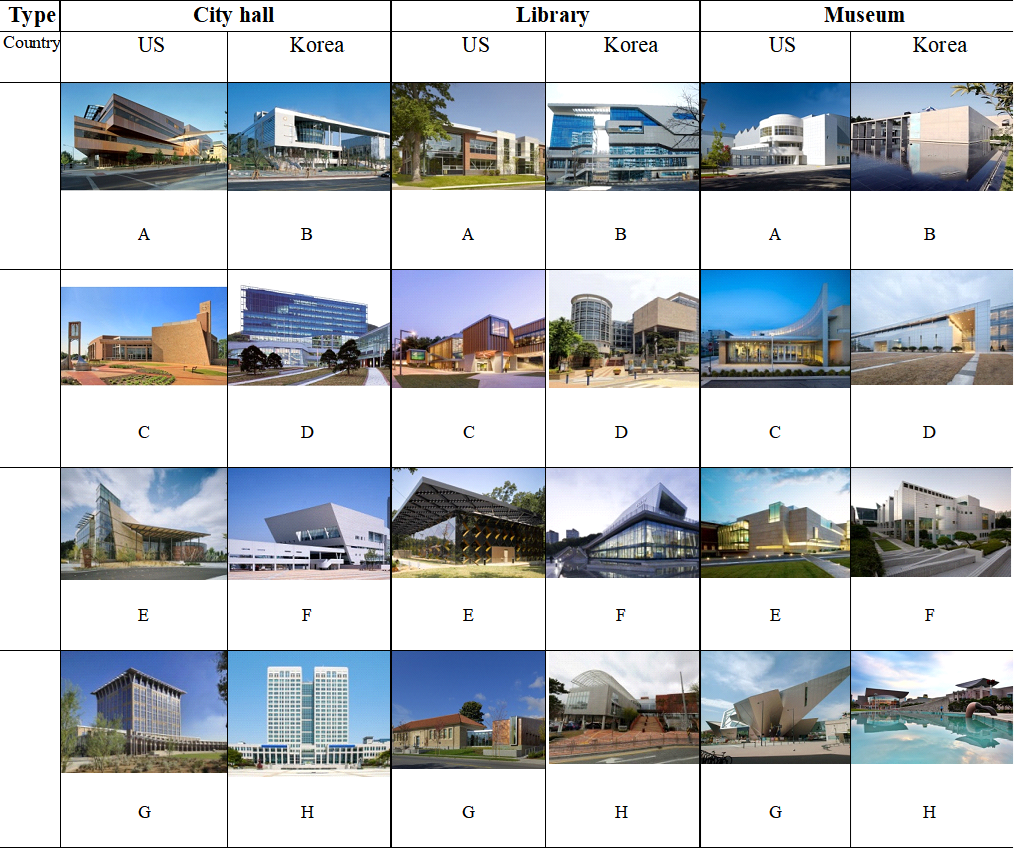
Data collection was conducted through an online survey for easy access in both countries. The link for the survey, constructed on the Qualtrics website, was sent to participants, and they completed it at their convenience. No time limit was imposed. The research was approved by the Institutional Review Board and conducted ethically. Survey instructions were written in both English and Korean. The survey was organized as follows: Participants were shown eight building images and asked to (a) write the type and building name to check their prior knowledge; (b) rank the eight buildings based on the typicality of design in each category; and (c) select five attributes as determinants of typicality. Building locations were concealed at all stages of the research process. Participants’ responses were analyzed using SPSS.
Interrater reliability of evaluating typicality was calculated using the Intraclass Correlation Coefficient (ICC) and reported in Table 2. Interrater agreement is excellent when the ICC is higher than 0.75 [34]. The ICC was calculated in the four groups (Korean experts, Korean nonexperts, American experts, and American nonexperts). The results showed high reliability in all items. In Korean responses, interrater reliability was the highest for the city hall; in American responses, for the library. For American experts, perception of the typical museum was diverse with relatively low reliability (.77).
| Building type | KEs (N = 50) | KNs (N = 50) | AEs (N = 44) | ANs (N = 49) |
|---|---|---|---|---|
| City hall | .94 | .91 | .88 | .90 |
| Library | .93 | .85 | .91 | .97 |
| Museum | .91 | .85 | .77 | .92 |
Note: KEs = Korean experts, KNs = Korean nonexperts, AEs = American experts, ANs = American nonexperts
Participants selected five determinants of typicality from the 20 attributes consisting of 10 formal and 10 subjective attributes, so the difference in the number of selections between the two attributes was calculated using the following formula:
For example, in the evaluation of city hall, if a participant selected two formal attributes and three subjective attributes, the difference was -1 (2 minus 3).
In order to check whether the determinants of typicality differed according to culture and expertise and according to the type of building, a 3 (type) x 2 (culture) x 2 (expertise) repeated measures ANOVA was conducted with one within-subject factor—type (city hall, library, and museum) and two between-subjects factors—culture (Korea vs. America) and expertise (experts vs. nonexperts). The three types of buildings were treated as replications in the ANOVA. Table 3 shows the results.
| Building type | KEs (N = 50) | KNs (N = 50) | AEs (N = 44) | ANs (N = 49) |
|---|---|---|---|---|
| City hall | .94 | .91 | .88 | .90 |
| Library | .93 | .85 | .91 | .97 |
| Museum | .91 | .85 | .77 | .92 |
Note. * p < .05, ** p < .01
The results showed that the effect of culture was significant (p \(<\) .01) in the selection of the determinants of typicality and that the effect of expertise was marginally significant (p \(<\) .05). No interaction between culture and expertise was found. The effect of type was also significant (p \(<\) .05). A pairwise comparison among three types of buildings revealed a significant difference between the library and city hall (\(M_{lib}\) =.23, \(M_{city}\) =.65, p \(<\) .01) as well as between the library and museum (\(M_{lib}\) =.23, \(M_{mus}\) =.65, p \(<\) .05). In the evaluation of the library, participants as a whole selected more subjective attributes compared to the city hall or museums.
The effect of culture and that of the expertise were further explored using a two-way multivariate analysis of variance (MANOVA). Table 4 shows the results, and Figure 2 shows the results in a graphical format.
| Koreans (N=100) | Americans (N=100) | F | p | η2 | |||
|---|---|---|---|---|---|---|---|
| M | SD | M | SD | ||||
| City hall | .34 | 1.75 | .96 | 1.89 | 5.63 | .019* | .029 |
| Library | -.10 | 1.85 | .57 | 1.93 | 5.99 | .015* | .031 |
| Museum | .24 | 2.03 | 1.06 | 2.01 | 7.92 | .005** | .040 |
| Experts (N=95) | Nonexperts (N=105) | F | p | η2 | |||
| M | SD | M | SD | ||||
| City hall | .62 | 1.95 | .66 | 1.74 | .002 | .961 | .000 |
| Library | -.02 | 1.73 | .45 | 2.06 | 2.75 | .099 | .014 |
| Museum | .30 | 2.03 | .96 | 2.04 | 4.83 | .029* | .025 |
Note. * p < .05, ** p < .01
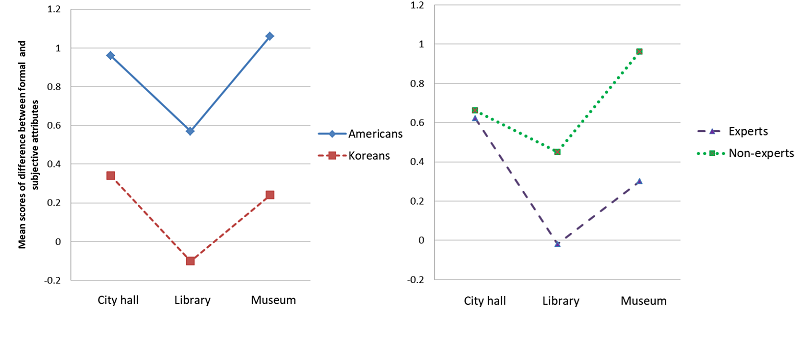
Significant difference by culture appeared in all three types of buildings. In particular, in the library evaluation, Koreans selected more subjective attributes than formal ones (\(MK_{lib}\)=-.10), whereas Americans chose more formal ones than subjective ones (\(MA_{lib}\) =.57). In the city hall as well as in the museum evaluation, both Koreans and Americans selected more formal attributes than subjective ones, but the degree was different: Americans selected more formal attributes (\(MA_{city}\) =.96, \(MA_{mus}\)=1.06) than Koreans did (\(MK_{city}\) =.34, \(MK_{mus}\)=.24). The effect of expertise appeared only for the museum; nonexperts selected more formal attributes (\(MN_{mus}\) =.96) than experts did (\(ME_{mus}\) =.30).
In summary, the results showed a significant difference in the determinants of typicality of public buildings in Americans and Koreans: Koreans chose more subjective attributes as determinants of typicality than Americans, who chose more formal attributes as determinants of typicality than Koreans. Thus, Hypothesis 1 was supported.
Participants were also asked to rank the typicality (i.e., looks most like a city hall to least like a city hall) of the eight building designs provided. Those buildings consisted of four located in Korea and four in the US. The country of origin of the buildings was concealed. In the city hall evaluation, Koreans rated Building D (located in Korea) as most typical; Americans rated Building C (located in the US) as most typical. The most typical city hall according to Koreans (Building D) was 20 stories high, symmetrical in shape, linear, rectangular, and mainly made of glass; in contrast according to Americans, the most typical city hall was Building C, one story, asymmetrical, curvilinear, and made of brick. Of the library stimuli, both Korean and U.S. participants rated Building A (located in the US) as most typical: two stories high and made of glass and bricks. Of the museum stimuli, both Korean and American participants rated Building G (located in the US) as typical: nonsymmetrical in shape with few openings and windows. In summary, the perception of the typical city hall for Koreans and Americans were very different, but no difference for the library and museum was found.
In order to check whether the evaluation of the typicality of building design differed among Koreans and Americans, the aggregated scores of the typicality of buildings located in each country were calculated, and a 3 (type) x 2 (culture) repeated measures ANOVA was conducted with building types as within-subjects variables and participant country as a between-subjects variable. Aggregated scores of typicality of buildings in Korea were first analyzed and appear in Table 5.
| Between-Subjects Source | SS | DF | MS | F | p | η2 |
|---|---|---|---|---|---|---|
| Culture | 81.07 | 1 | 81.07 | 118.10 | .00** | .38 |
| Error | 131.12 | 191 | .69 | |||
| Within-Subjects Source | SS | DF | MS | F | P | η2 |
| Type | 29.14 | 2 | 14.57 | 22.64 | .00** | .11 |
| Type x Culture | 6.43 | 2 | 3.22 | 5.00 | .007** | .03 |
| Error | 245.80 | 382 | .64 |
Note. * p < .05, ** p < .01
The results showed the effects of culture, type, and the interaction between type and culture were all significant, which means aggregated typicality differed by culture as well as by building type. Because interaction between type and culture was found, the relationship was explored further using a pairwise comparison. The results revealed a significant difference in the rating of typicality of building types—in the city hall and museum (\(M_{city~in~Korea}\) = 4.74, \(M_{mus~in~Korea}\) = 4.21, p \(<\) .01) as well as in the library and museum (\(M_{lib~in~Korea}\) = 4.61, \(M_{mus~in~Korea}\) = 4.21, p \(<\) .01), but no difference was found in the city hall and library. In other words for people overall, city halls in Korea were perceived as more typical than museums in Korea; libraries in Korea were perceived as more typical than museums in Korea. The effect of culture was further explored using a univariate analysis of ANOVA. Table 6 shows the result, and Figure 3 shows the aggregated typicality rating by culture in graphical format.
| Aggregated Typicality | Koreans (N=100) | Americans (N=93) | F | p | η2 | ||
|---|---|---|---|---|---|---|---|
| M | SD | M | SD | ||||
| (1) City halls in Korea | 5.25 | .84 | 4.22 | .77 | 78.02 | .00** | .29 |
| (2) City halls in US | 3.75 | .84 | 4.78 | .77 | 78.02 | .00** | .29 |
| (1)-(2) Difference | 1.5 | 1.68 | -.56 | 1.55 | 78.02 | .00** | .29 |
| (1) Libraries in Korea | 4.96 | .83 | 4.26 | .82 | 34.36 | .00** | .15 |
| (2) Libraries in US | 4.04 | .83 | 4.74 | .82 | 34.36 | .00** | .15 |
| (1)-(2) Difference | .92 | 1.65 | -.48 | 1.64 | 34.36 | .00** | .15 |
| (1) Museums in Korea | 4.47 | .84 | 3.96 | .75 | 20.47 | .00** | .10 |
| (2) Museums in US | 4.53 | .84 | 5.04 | .75 | 20.47 | .00** | .10 |
| (1)-(2) Difference | -.06 | 1.69 | -1.09 | 1.50 | 20.47 | .00** | .10 |
Note. * p < .05, ** p < .01
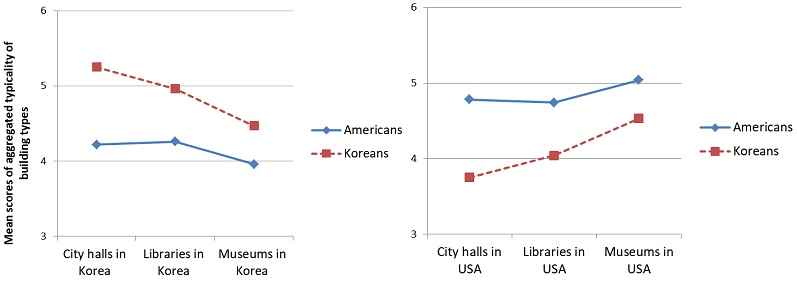
To illustrate, Americans rated all three types of buildings located in the US as more typical than Koreans did. Likewise, Koreans rated all three types of buildings located in Korea as more typical than Americans did. When calculating mean difference between aggregated typicality of buildings in Korea and those in the US, the difference was largest in the city hall (\(M_{difference_city}\) = 1.5), library (\(M_{difference_lib}\) = .92), and museum (\(M_{difference_mus}\) = -.06) in that order for Koreans; but the order was different for Americans: museum (\(M_{difference_mus}\) = -1.09), city hall (\(M_{difference_city}\) = -.56), and library (\(M_{difference_lib}\) = -.48). Koreans seemed to have strong national culture with regard to city halls, but Americans had such in museums. In summary, participants perceived buildings designed by local architects and located in their own country as more typical than those designed and built elsewhere. Thus, Hypothesis 2 was supported.
This study shows cultural difference in the determinants of typicality in Americans and Koreans. Koreans considered more subjective attributes compared to Americans, who considered more formal attributes in the evaluation of the typicality of building designs. Difference according to expertise was found only in the evaluation of museums. This indicates a greater difference in determinants by culture than by expertise. Some probable reasons can be found in the literature and are worthy of discussion.
The first is that the selection of prototype categorization involves a schema, which correlates with the meaning, cognitive properties, and thinking system in a culture. A schema refers to the “knowledge structures that govern thought by selective attention, retention, and use of information about a particular aspect of the world” [28, p. 565]. People have “a full set of schema for every category of objects” [16, p. 304]. Culture shapes the content of people’s thought through shared knowledge structure, and those thought and cognitive processes operate in everyday activities. Thus, people of the same culture who live in same place or the same country are likely to share a similar cultural schema and memory. Miyamoto, et al. showed that “perceptual environments have been historically constructed and maintained by people repeatedly exposed to a culturally specific perceptual environment” [35, p. 118]; thus, cognitive thinking can be shaped by the environment. Thinking style is a byproduct of culture.
Nisbett and Masuda [36] attributed difference in cognitive thinking and attention in Westerners and East Asians to the dissimilarity in perception, driven by social structure, practices, and environment. East Asian countries have more complex and hierarchical social networks, more complex physical environments, and social structures emphasizing interdependence and harmony than Western countries, where emphasis is placed on logic, individual objects, and independence. In the evaluation of typicality of building design in the current study compared to Americans, Koreans appeared to focus less on detail and individual elements of the building but more on its context, relationships, and feel.
The second reason is that identifying a building type strongly relates with one’s history of exposure and familiarity, so culture may play a more important role in the perception of typicality than expertise, constructed during a relatively brief education. Lang noted the two cultures to which designers belong: Environmental designers . . . are members of two cultures embedded in each other . . . . One is the broader society and the other is the professional culture, which has its own norms of behavior, values, and expectations. [30, p. 98]
Here, the broader society can be interpreted as culture and professional culture as the design community, whose members are trained and educated. Even though the teaching and learning of the common features of certain types of building design are provided in architectural education, students’ experience and frequent encounters with building designs may influence their grasp of typicality more profoundly than expertise.
This study also reveals the perception of typical buildings differed per building type and per culture. Koreans perceived city halls in Korea as more typical than other types of buildings in Korea, and Americans perceived museums in the US as more typical than other types of buildings in the US. This indicates that Koreans have a clearer perception of the typical city hall, and Americans have it of the typical museum. The debate on the design of the new Seoul City Hall in South Korea shows that Koreans are sensitive to the design of the typical city hall, and whether it can manifest the symbolic aspects of a city hall, convey harmony with the context and neighbor buildings, express a sense of place, and match with its purpose is a significant issue for Koreans [1, 26]. The reason for higher typicality for city halls in Korea may be that the city hall is a type of building in which the concept of authority plays a role. Among the 20 attributes, the top determinants selected for typicality of the city hall by participants of both countries were size or volume and authoritative or nonauthoritative feel of the building.
This study also shows that people evaluated buildings located in their country as more typical than others without knowing the origins of the buildings. Although the eight selected stimuli may not have covered all ranges of design of that particular building type, they varied in terms of size, shape, and materials. The results indicate that existing buildings contain a certain degree of typicality.
Two implications emanate from this study. First, by revealing cultural difference in cognitive thinking when selecting determinants of the typicality of building design, this research expands the discourse of typicality into the area of architecture design and provided insights on how people perceive and judge building design. In fact, most of the discussions of determinants of typicality have been confined to linguistics, cognitive psychology, and product design. Loken and Ward [21] stated that “a better understanding of typicality may provide more insight into how products are remembered, learned, compared, and chosen” (p. 111). Knowledge of cultural differences in the perception of typicality will help architects approach their designs for clients in other cultures more wisely by reflecting upon important determinants in those cultures and preparing themselves for the cultural context. The process of design, planning, policy, and programming can be facilitated if cognitive thinking about typicality and the way people describe and evaluate building design are understood.
Second, this study reveals the existence of the interaction of culture and type in typicality, and the tendency of people to perceive buildings constructed in their own countries as more typical. What people regard as cultural identity may be already infused in typical building designs so when architects want to express cultural character, they may not necessarily need to represent traditional building styles. In other words, searching for cultural identity may entail finding shared features among buildings similar to one another. Therefore, foreign designers will gain insight by reviewing shared features of building designs of the same type when they plan to design a certain type of building in another country.
One limitation of this study is the use of upper level architecture students as expert group along with professionals as a way to contrast with non-architecture majors. Although senior architecture students have a certain degree of expertise so that they can be in contrast with non-majors, they are not equivalent with professionals. Thus, future research with more experienced participants with a similar level of expertise will be beneficial in revealing any effect of expertise in determinants of typicality along with culture. Future research of characteristics of preferred building design in terms of the 20 determinants and whether such attributes are perceived differently in various cultures will be worthwhile. Moreover, understanding the determinants of typicality with the use of eye-tracking devices will be valuable in tracking which attributes people see when judging the typicality of a building to reveal patterns in the relationship of visual perception and evaluation.