

Traditions and customs come to the fore in the formation of the social and cultural environment. The combination of these concepts creates urban identity. The word ‘identity’ derives from the Latin word identitas. Identity, a philosophical term, carries the meaning specific to a place [1]. The meaning and dimension of the word identity is wide. This term can be derived under various subheadings such as personal, social, and cultural identity [2]. There are levels of use of the term identity from the personal to the global scale. The term ‘urban identity’ is used to define a place or region [3]. In the construction of the built environment, urban-specific settlements are created by ensuring sociocultural diversity. Systems are developed in line with the needs of the region and harmony and integration are ensured.
The underground resources and living needs of the region form the basis of the urban identity by creating the standards of the people living in that region [4]. At this point, each region has its own unique and distinctive features. When looking at the city and built environment from a regional scale, it can be seen that there are different variations [5]. There are structures that affect the identity of the city at many stages from micro level to macro level [6]. People migrating from one region to another are also effective in the formation of urban identity [7]. In this direction, the main factors in the formation of urban identity are people, physical elements and culture [8]. These factors create the distinctive features of cities and provide diversity [9].
The concepts of ‘identity’, ‘place’, and ‘memory’ are the subject of thought, discussion and research, especially in rapidly transforming societies in periods when the legacies of the past are constantly in danger of being erased and collective memory is being revised [10]. Focal points and symbolic structures in cities reveal the memory-space relationship [11]. In this relationship, historical artifacts where past events took place have a greater role. What is remembered or known about the collective past, including written, verbal and material sources, strengthens the memory-space relationship [12]. Within the built environment, buildings do not only create the memory-space relationship of the city. Geographical features and landscape studies are also complementary elements in urban identity [13]. When New York is mentioned, Central Park comes to mind, and when China is mentioned, the Great Wall of China comes to mind [14]. These urban elements, engraved in memories in cities, serve a specific function and also shed light on the psychological, spiritual, and historical background of the cities. Places and spatial elements, which have an important place in symbolizing cities, are protected for sustainability and transferred to future generations [15].
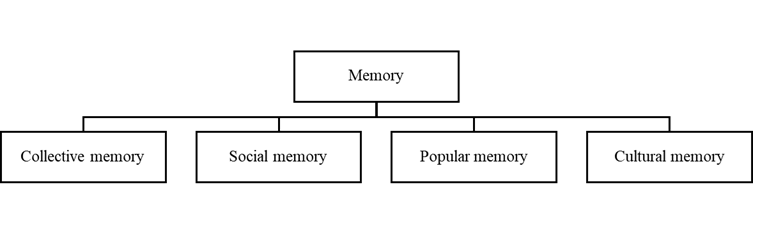
Memory, in general definition, is the ability of human beings to keep in mind the information they have experienced or learned in various ways. According to information obtained from the literature, memory is divided into four distinct categories: collective, social, popular, and cultural (Figure 1) [16]. Historians, sociologists, anthropologists, and psychologists have offered different definitions of memory categories [17]. Collective memory is formed as a result of the traces left by any event experienced by more than one person, a society or a community. This type of memory moves from individual experiences to the collective consciousness [18]. Social memory encompasses cognitive processes that affect daily life, such as information processing, encoding, storage, and retrieval, which play a role in social interaction [19]. Popular memory includes categories such as folklore and cinema, and varies according to current trends by interpreting the past. In this respect, it is a type of memory that deepens a society’s past events, traditions, and customs by visualizing them. Cultural memory is the recall of events associated with experiences and places by individuals or groups operating within social frameworks [20]. Many disciplines, including psychology, sociology, and geography, contribute to the study of cultural memory [21, 22]. These categories mutually reinforce each other.
Lin et al. [22] discussed the changes in the self-definition of immigrants during the acculturation process in urban China. As a result of the study, it was seen that most immigrants preserved their rural identities. Belanche et al. [23] examined identity differences between people living in rural and urban areas. It is aimed to fill the research gap in this field by understanding the role of community type in environmental and social psychology. Bernardo and Palma-Oliveira [24] aimed to bring the concept of urban identity into the context of relations in urban space by using the social identity approach. Fieldwork on urban identity was conducted in four adjacent neighborhoods in the city of Lisbon. Lelandais [25] investigated the role of identity and space in the emergence of social role in the neoliberal context. Attempts to evict the residents of the neighborhood from their settled order through public projects created resistance and it was not desired to disrupt the neighborhood order. Enache and Craciun [26] emphasized the importance of natural or anthropogenic landscape in the process of creating an urban identity in the context of globalization and cultural homogeneity.
The relationship between the concepts of urban identity, memory and space requires a multidisciplinary approach. The fact that a city structure consists of historical or contemporary textures causes the memory and space parameters to change in terms of perception. Historical or contemporary city textures are shaped by lifestyles, buildings, landscapes, climate, and topography [27]. The historical city structure triggers the elements of retrospective memory, while the contemporary city structure triggers the elements of memory for the future [28]. For example, the urban texture of Mardin, located in the Southeastern Anatolia Region, is specialized with narrow streets, stone structures and the lifestyles of past civilizations. In this direction, a specific cultural memory-space perception has been formed [29]. The closeness of buildings and places to each other increases the interaction between people and creates more memories. Depending on the climate and topography, lifestyles also change and strengthen the memory-space relationship.
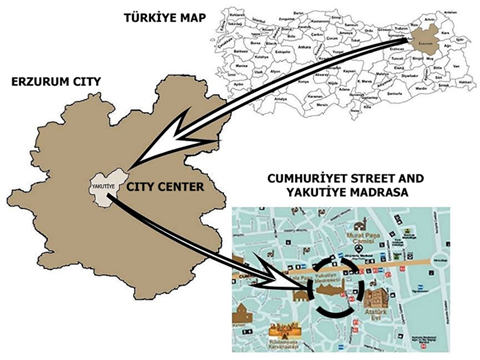
It was observed that psychological studies on urban identity issues were concentrated. Additionally, relations between societies were investigated by comparing rural and urban. However, it has been observed that studies on the factors that cause the symbolic structures of cities to become memory-spaces are limited. However, there are very few studies that address the interrelationship between memory categories, space use, and urban heritage. Studies addressing the relationship between memory-space are limited, and this interdisciplinary study contributes to the literature in this regard. The aim of the study is to fill this research gap in the literature. This study contributes to the memory-space relationship while strengthening the methodological framework with survey-based evidence. The scope of the study was conducted specifically in Erzurum province in Türkiye. Erzurum was chosen because it has a deep-rooted history and lived experiences. This city, which has hosted many civilizations in the past, yielded findings on the city-memory relationship. In this regard, Cumhuriyet Street and Yakutiye Madrasa, where construction and vehicle-pedestrian circulation is intense in Erzurum city center, were discussed. The memory-space features in Erzurum were revealed and the factors that led to the symbolic mention of Yakutiye Madrasa in the city were evaluated.
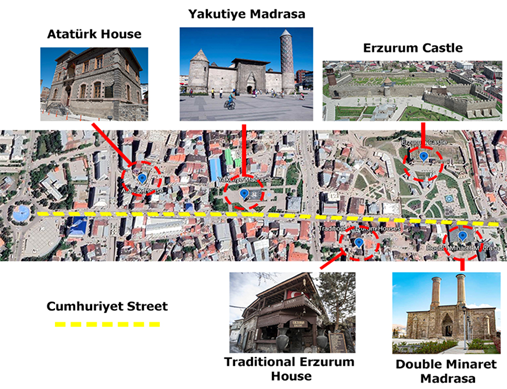
Economic, cultural, social, geographical, and historical factors play a role in the formation of a city or region. These factors include the urban elements and built environment that form the urban identity of each city. All 81 provinces in Türkiye have urban facilities that form their individual urban identities. Within the scope of the study, the city of Erzurum in Türkiye was discussed. Erzurum has a deep-rooted history and many historical monuments. It is seen that there is a lot of historical construction in the city center, especially on Cumhuriyet Street. There are historical buildings such as Erzurum Castle, Double Minaret Madrasa and Erzurum Ulu Mosque on this street. Narmanlı Mosque and Three Cupolas historical buildings are also located close to this street. This street in the city center and the Yakutiye Madrasa on this street were chosen to be examined within the scope of the study because it contains more than one historical monument and has a high population (Figure 2). Additionally, one of the main reasons for choosing Yakutiye Madrasa and its built surroundings is the high level of integration between the square and the buildings, and the efficient flow of pedestrian traffic. The Yakutiye Madrasa and its surrounding area, which have symbolic and historical significance, also function as urban anchors through their daily use.
The main purpose of the study is to reveal the memory-space features of Yakutiye Madrasa and its surroundings. In this context, the qualities that make a place/building a “memory-space” were investigated and the criteria in the memory-space relationship were determined in the case of Yakutiye Madrasa. Yakutiye Madrasa is a historical building and, in this respect, it has a historical quality. Furthermore, the use of the building as a museum gives it a monumental identity and quality. In the building, which is integrated with the square in front of it, the presence of tearoom activities in the summer months and the organization of Ramadan festivals, which are religious rituals, make the building a focus of events and meetings. Yakutiye Madrasa and its surroundings, which offer people rest and activity opportunities in daily life, are described as a meeting place. Sub-criteria have been determined to question the memory-space relationship. Analyses were made by establishing connections between the sub-criteria and the survey. Survey questions were designed according to the determined qualifications and criteria. The fifth, sixth, seventh, and eighth questions reveal the qualitative part of the building. The sub-criteria of the memory-space relationship were linked to the fourth and seventh questions.
These criteria were categorized as collective, social, popular, and cultural memory and were used in the methodology of the study. The first three questions are designed to get to know the person taking the survey, providing a foundation for the other five questions. The fourth question is designed to assess a person’s memory in general. It prompts the individual to explore all memory categories related to a past event. The fifth and sixth questions are intended to guide visitors to the building and its surroundings, to refresh their memories if they have previously visited the building or participated in any activities within its environment. These questions also test memory, laying the groundwork for questions seven and eight. While questions four, five, and six generally emphasize memory, questions seven and eight delve into categories of memory. Accordingly, the survey responses indicate which memory category plays the most active role for each individual.
In the method of the study, a survey study was used in addition to the data obtained from literature studies. Yamane formula, a statistical method, was used to determine the minimum number of participants in the survey study, and this formula has been used in many studies in the international literature [30–32]. This formula is based on a 95% confidence level and a 5% margin of error. Yakutiye district of Erzurum, where the survey was conducted, has a population of approximately 200 thousand people and according to the Yamane formula, a minimum of 132 people is required to participate in the survey. In this context, the reliability of the study was increased by conducting a face-to-face survey with 160 people in Cumhuriyet Street, Yakutiye Madrasa and its surroundings. 160 people voluntarily participated in the survey. Care was taken to select these participants according to different age groups. In the survey study, 8 questions were asked to the participants and the answers obtained were recorded in the previously prepared forms. The answers obtained were classified and the memory-space relationship of Yakutiye Madrasa, one of the symbolic structures of Erzurum, was discussed. The content of the survey is given in Table 1.
| Question Number | Question |
|---|---|
| 1 | What is your gender? |
| 2 | How old are you? |
| 3 | Are you from Erzurum? |
| 4 | What is the name of the building you see behind you? |
| 5 | What function is the building you see behind you (Yakutiye Madrasa) used today? |
| 6 | Have you visited the Ethnography Museum inside the building? |
| 7 | What does the building remind you of? |
| 8 | Where is your meeting place with your friends on the Cumhuriyet Street axis? |
In the study, Cumhuriyet Street in the city center of Erzurum, which is the most lively and busiest, was chosen. The reason for limiting the study area to Cumhuriyet Street is that there are a lot of historical buildings in this region and accordingly, the memory-space relationship in the urban identity can be evaluated effectively. Research questions were designed to reveal the memory-space relationship. The first and second questions were created within the scope of getting to know the person participating in the survey and obtaining data for analysis. The question ‘Are you from Erzurum?’ in the third position constitutes the first step of the analysis for synthesis. The answers to this question are the basis of the memory-space relationship because someone from Erzurum has more information about Yakutiye Madrasa and its surroundings. The fourth, fifth, and sixth questions examine the place of Yakutiye Madrasa in the urban identity and the concept of space. However, the answers to the fourth and seventh questions provide results on the memory-space relationship. The eighth question measures the importance of Yakutiye Madrasa within the urban identity. In this question, depending on the answers given to the survey, the most important building and its surroundings that form the urban identity of Erzurum were also determined.
Erzurum is one of the cities targeted for modernization and development by making a zoning plan in the years when the Republic was first declared in Türkiye [33]. It is seen that Cumhuriyet Street, which has operated as the main axis from past to present, is also defined as the main axis in the Lambert Plan. The city of Erzurum was founded on a land at the foot of Palandöken Mountain, on the edge of a wide plain in the upper Euphrates basin. Located in northeastern Türkiye, the city is on a plateau surrounded by mountains. The surface area of Erzurum, one of the most important winter tourism centers of the country. It is the largest city in the Eastern Anatolia Region and the fourth largest city in Türkiye in terms of surface area [34]. The city, which is one of the coldest cities in Türkiye with an altitude of 1950 meters above sea level, has a deep-rooted historical past. Cumhuriyet Street and historical buildings that cover the study area and have a significant impact on the formation of the urban identity of Erzurum city are given in Figure 3.
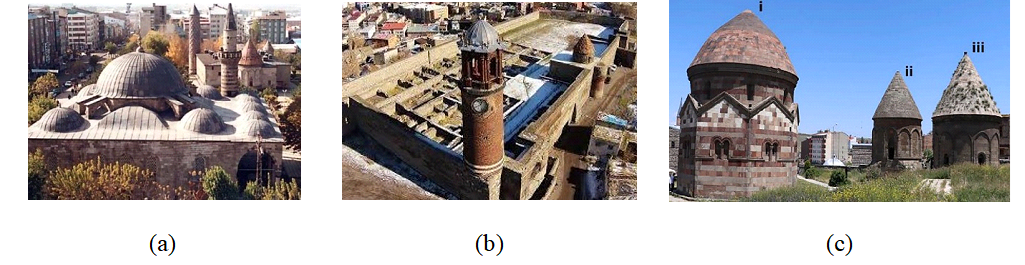
The stone monuments in Erzurum, which was founded on the historical Silk Road, consist of works of various civilizations built between the 4th and 17th centuries [35]. Stone works such as Rüstempaşa Bazaar (Taşhan), Lalapaşa Mosque, Erzurum Castle, and Three Cupolas were built during the Ottoman Empire and are among the symbolic structures of the city [36]. Lalapaşa Mosque is the only work of Mimar Sinan in Erzurum and the first mosque of the Ottoman Empire in Erzurum (Figure 4). Lalapaşa Mosque continues to function as a religious building [37]. Erzurum Castle is located on a sloping land. The building, located on Cumhuriyet Street, was built as an inner and outer castle [38]. Three Cupolas are located to the south of the Double Minaret Madrasa and the Ulu Mosque. These buildings, called Emir Saltuk Cupola, II. and III. Cupola, were built from stone building material (Figure 4). In addition to religious and military buildings, baths are also part of Erzurum’s urban identity [39].
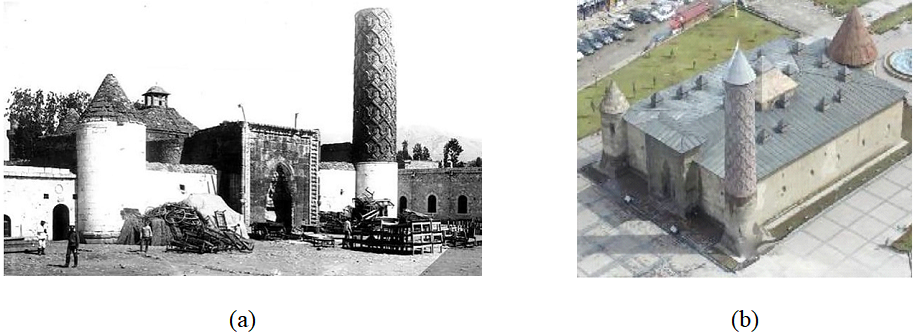
Double Minaret Madrasa and Yakutiye Madrasa are the most well-known buildings in Erzurum. Yakutiye Madrasa was built by Emir Cemaleddin Yakut in the 14th century (1310). It is an example of the madrasa type with a closed courtyard, iwan, and portico in Anatolia [40]. It has high historical and artistic value with its symmetrical structure, stone reliefs of various figures and tile decorations [41]. Yakutiye Madrasa operated as a foundry for a long time during the Ottoman period (Figure 5). It is known that it was used as a military warehouse from the late 19th century until the Republican period. Yakutiye Madrasa has a rectangular plan and there are classrooms and facing iwans around its central courtyard. The madrasa was built with wide-span arch roofs in the east-west direction, in addition to the main dome perched on four columns in the middle and half domes on all four sides [42]. It is a frequent destination for visitors with its urban furniture in the square in front. The surrounding square, with its landscaping elements and walking paths, constitutes one of the crossing points of the city.
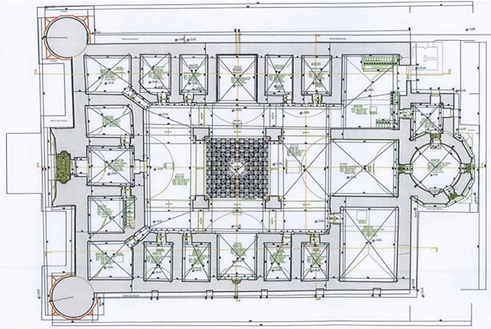
Yakutiye Madrasa, which has a closed courtyard, three iwans, a portico, and a large part of which is single-storey, has a second floor only above the entrance iwan. The madrasa has an area of 33.4 x 24.4 meters on the plan plane (Figure 6). The main dome is placed on a square form with a side measuring 7.75 meters and is 12.9 meters high. The cupola located in the east of the building measures approximately 12 x 6 meters. There are two minarets with a height of 21.2 meters in the northwest corner of the madrasa and 8.25 meters in the southwest corner [43]. The building was repaired three times during the Republic period, by the Directorate General of Foundations (1964-1973) and the Ministry of Culture and Tourism (1991). There were no significant changes in the architecture of the building during the repairs, only minor restorations were made. Yakutiye Madrasa today serves as the Erzurum Turkish-Islamic Arts and Ethnography Museum [44].
Human memory is based on visualization in addition to time-related data. These visualizations are at spatial and volumetric scale. Events that occur depending on past experiences transfer traces from the place to memory. These traces form the basis for the formation of memories. Place is an important element for keeping memory alive and preserving it. The interaction of space with memory reveals the reproduction of the past within the framework of a reciprocal relationship as a result of a certain experience. Although space is a product of experiences, it also includes a production phenomenon that creates experiences. Images and symbols in urban space become normal as a part of daily life and are encoded and processed in memory. Spatial memory is used to find direction, get from one place to another, describe a place, and perform ordinary routines. In this context, space forms the memory-space perception by interacting with the physical environment and social structure, thanks to its relationship with time. Memory for specific experiences is characterized by an organization of events in time [45, 46]. The use of Yakutiye Madrasa and its surroundings for different functions over time strengthens the memory-space relationship. In the study, Cumhuriyet Street, one of the focal points of the city of Erzurum, where the memory-space relationship is established, and Yakutiye Madrasa, located in an important location of this street, were discussed. At this point, survey research was conducted as a data collection instrument. The results of the survey conducted on Yakutiye Madrasa and its surroundings are given in Table 2.
| Question Number | Response | Number of people | Percentage rate |
|---|---|---|---|
| 1 (Gender) | Male | 84 | 52% |
| Female | 76 | 48% | |
| 2 (Age) | 18-25 | 66 | 41% |
| 26-35 | 40 | 25% | |
| 36-50 | 54 | 34% | |
| 3 (City) | Erzurum | 126 | 79% |
| Other | 34 | 21% | |
| 4 (Building) | Yakutiye Madrasa | 143 | 89% |
| Other | 17 | 11% | |
| 5 (Function) | Museum | 135 | 72% |
| Unknowing | 25 | 28% | |
| 6 (Visiting) | Yes | 93 | 58% |
| No | 67 | 42% | |
| 7 (Connotation) | Historical value | 62 | 39% |
| Tearoom | 49 | 30% | |
| Ramadan festivities | 35 | 22% | |
| Other | 14 | 9% | |
| 8 (Meeting place) | Yakutiye Madrasa and its surroundings | 104 | 65% |
| Other | 56 | 35% |
In the survey prepared in line with the answers of 160 people, it was observed that the participants showed a balanced distribution in terms of gender as men and women. Participants are generally in the young and middle-aged category. The participants in the study are mostly from Erzurum. Almost all of the participants stated the name of the building shown as Yakutiye Madrasa. This situation shows that the madrasa has an important position in the identity of the city and is an indication that it is at the forefront in the memory-space relationship. The reason for this is that the building is not used as a madrasa today. This means that the function of the building, which was originally built as a madrasa, is not forgotten by the participants, although it is used for functions such as museums and tearooms today. It was observed that the participants who coded the building as a madrasa in their memory had knowledge about the historical background of the building. The majority of survey participants know the function of the building. In this direction, the interest of the participants in the building emerges and it has been determined that there is awareness. Although the function of Yakutiye Madrasa is known, the number of people entering the building and visiting it is relatively low. Behind the authentic appearance of the building are places where historical artifacts and Erzurum culture are exhibited. In addition to the building being seen as a historical artifact and a symbolic structure, it has been determined that the activities around it are remembered within the scope of the memory-space relationship.
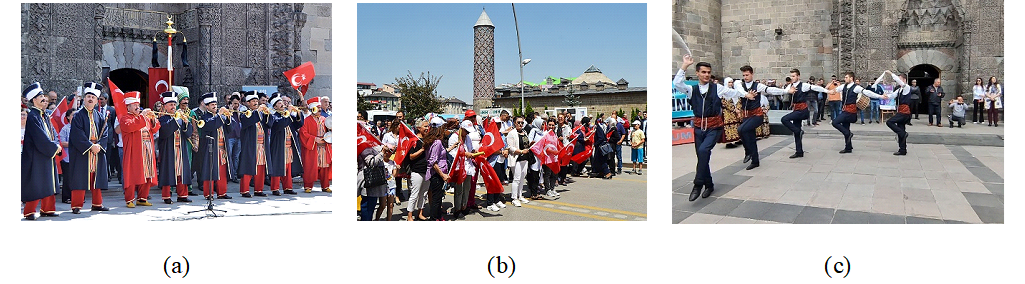
In the study, time, space, individual, and collective contents of memory were examined as an indicator of the survey results. The younger population participated more in the research. The education level of the young population in Erzurum has increased in recent years and this shows that a more conscious generation is growing up [46]. There are two universities in Erzurum, and considering that educational facilities are improving day by day, the awareness level of the young generation is also expanding. The fact that there are two universities in the city also shows that it is a student city. Since it is a student city, it is a socioeconomically suitable city. In Erzurum, the young population is more social than the older population and is more active on Cumhuriyet Street. In this regard, the young population, which constitutes the majority of the participants in the survey, mobilizes Yakutiye Madrasa and its surroundings. Especially in the summer months, the tearoom around the building increases the interest in the madrasa. Entertainments such as events, exhibitions, shows during holidays and concerts held in and around the square in front of Yakutiye Madrasa during Ramadan also increase circulation and ensure the continuity of the liveliness of the building (Figure 7). The region, which is preferred by more than half of the participants as a meeting place in Erzurum, shows that Yakutiye Madrasa is in a strategic location and is at a symbolic point in terms of memory and space.
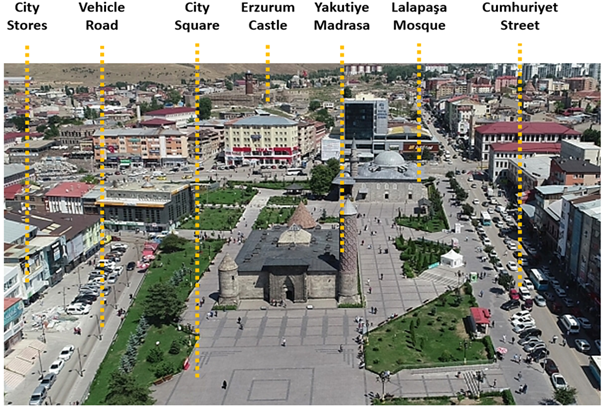
Yakutiye Madrasa is located in a busy and crowded part of the city where stores are located (Figure 8). The madrasa is located within the city square and occupies a central location. The Lalapaşa Mosque is also located within the city square. The square is surrounded by roads. One of these roads is Cumhuriyet Street, which is the main artery of the city center. This settlement is also quite close to Erzurum Castle. Lalapaşa Mosque, Erzurum Castle, and Yakutiye Madrasa are historical landmarks and symbolic structures of the city. The city square connects these landmarks, bringing vibrancy to the area. This vibrancy also increases tourist activity and contributes to the city’s appeal. The presence of stores and historical sites in the area increases the population density and affects the visibility of the Yakutiye Madrasa and its surroundings. In daily life, people spend time in this area, influenced by the unifying effect of the square. In addition to daily life, the Lalapaşa Mosque, where people perform their religious duties, especially after iftar during Ramadan, keeps the square bustling in the evening hours. This area appeals to both young and old populations.
According to the questions asked to the elderly population, it has been observed that they are answered with experiences within the traditions and customs of the past. The young population, on the other hand, researched the philosophy of historical events as well as the information they heard from the older population. The fact that the young population learns about the historical past of the city by researching it has enabled historical places to be kept alive by gaining a place in their memories. At this point, it can be said that collective memory plays an active role. Similar structures such as the madrasa, castle, and Three Cupolas in Erzurum are also found in Kars and Van in the Eastern Anatolia Region. Ani Ancient City (Ani Ruins), located in an archaeological area in Kars, and Akdamar Church (the Church of the Holy Cross) in Van, are related to the historical texture of Erzurum. The historical texture of the region also influences collective, social, popular, and cultural memory.
When we look at the memory categories and the memory-space relationship of Yakutiye Madrasa, the answer to the question ‘What does the building remind you of?’ in the survey study was historical value, with the highest response rate of 39% from the participants. In addition, it was learned that they took their guests from out of town to visit this building, which is one of the historical values of Erzurum. In this regard, it has been determined that Yakutiye Madrasa has a place in the cultural memory of the participants according to the memory classification in the literature. The second answer to the same question, tearoom, with a rate of 30%, indicates a long-standing activity in the madrasa garden. It was observed that the participants even remembered the topic of their conversations in the tearoom. In the context of this answer, it has been seen that Yakutiye Madrasa also provides the social and popular memory categories included in the memory classification in the literature. Additionally, it was noted that activities like card games at the tearoom are played collectively rather than individually. This fosters popular culture and strengthens collective memory. However, the tearoom represents an intimate environment for participants. It has been observed that people strengthen social bonds by sharing developments in their daily lives, and in this way, social memory is kept alive.
Participants gave the answer of 22% and the third place was Ramadan Festivals. They said that they came here to participate in the festivities held in the garden of Yakutiye Madrasa, especially right after iftar. Participants stated that unity and togetherness were fostered in and around the Yakutiye Madrasa during Ramadan. Therefore, it can be concluded that the Ramadan festival, even if only once a year, strengthens the bonds between people and creates a warm and welcoming atmosphere. This also contributes to social memory. With this answer, it was determined that the building and its surroundings fit the terms social and popular memory in the literature. In this location, Ramadan festivals are a long-standing tradition and also evokes cultural memory. Finally, 4% of the participants said that the Democracy Watches, which were held for days after the July 15 coup attempt, remained etched in their memories. In line with this answer, it has been observed that Yakutiye Madrasa and its surroundings revive memories that are collective and popular memories.
As a result, with the survey conducted, it was determined that Yakutiye Madrasa and its surroundings have an important place in the integration of memory-space relationship in the urban identity. In line with the survey responses, it was observed that the terms collective, social, popular, and cultural memory were linked to the building and its surroundings and were present in the participants’ memories, while a sufficient connection regarding collective memory was not established. It was determined that the participants chose Yakutiye Madrasa to meet because of its location and the popular cultural elements around it rather than its historical value.
The identity of a nation is a whole of abstract and concrete values that keep that nation alive. Important determinants of urban identities are generally shaped by the historical textures of settlements (castles, mosques, madrasas, palaces, traditional houses, etc.). These historical textures take a place in memory according to their different physical or social characteristics. Places in memory have both concrete and abstract values. For this reason, the cultural identity maintained by the memories of the places represents the spirit of the place. Keeping the social spirit alive and ensuring cultural continuity is possible by ensuring the sustainability of memory places. The mutually productive interaction between history, architecture, commemorative value, economic, and social developments and space is an indicator of the connection between space and memory. The flow of time is understood thanks to the holistic relationship that memory establishes with time and space.
With the effect of memory, experiences are experienced in time/space. Human beings redefine space as a concept in which their past experiences are coded through perceptions that enable them to understand their own existence. In this context, it can be said that the existence structure of the city, which is a manifestation of human action, is both temporal and spatial. The temporal process encoded in the city emerges as a memory model. In this context, the city is a direct factor for the preservation and alive of memory. The city is both a social production and a phenomenon that produces social existence. The memory of the city enables the understanding of the meaning of identities, selves and society formed today through the space produced by vitality.
Every city has its own unique architectural structure, lifestyle, in other words, an identity. Historical and cultural accumulation constitute the basic values of urban identity. The memory of the city or social memory comes together with the integrity of space-time-moment-identity. Urban memory is a result of the impressions on people who experience social and spatial change over time. In the study, evaluations were made to determine the place of Yakutiye Madrasa in human memory, which forms an important part of the city identity with the combination of historical and cultural components located in Erzurum city center. Within the context of the categories of the concept of memory, the spatial interaction of the Yakutiye Madrasa has been examined. In this direction, as a result of the survey applied to 160 participants, inferences were made regarding the memory-space relationship of Yakutiye Madrasa and its surroundings.
Based on the participants’ survey responses, the organized methodological questions revealed the memory-space framework. Based on the participants’ survey responses, the organized methodological questions revealed a memory-space framework. Survey-based evidence showed that Yakutiye Madrasa and its surroundings have a memory-based past in addition to their historical and symbolic past. In this context, survey responses that are linked to memory concepts explain that the madrasa and its surroundings are not only situated within an architectural and urban context, but also permeate the feelings and thoughts of a society.
It is envisaged that in future studies, the memory-space relationship can be discussed in a broad perspective by focusing on the city as a whole, including the districts of the cities. In this context, it is thought that the effects of the psychological and spiritual aspects of people living in the city on their urban identity can be investigated. However, it is envisaged that the dynamics between physical spaces and human experience at the scale of urban identity can be deepened with technological equipment and tools.
The author(s) declared no potential conflicts of interest with respect to the research, authorship, and/or publication of this article.