

Modern society is showing an aging trend due to improvements in income levels and medical technology. Reflecting this trend, it can be observed that the construction of medical facilities is continuously increasing. Medical facilities projects require the consideration of uncertain changes in space or facility demand during the planning and design phases. The reason is that medical facilities involve numerous stakeholders, including medical staff, patients, and healthcare providers. In particular, medical facilities involve numerous stakeholders, primarily medical staff, necessitating a process to gather diverse opinions. One study attempted to resolve the issue of coordination among stakeholders in uncertain situations by utilizing game theory [1]. In this regard, there are many special characteristics compared to other construction projects in terms of facility level and scale. First, for medical facilities, changes requested by the client throughout the design and construction process can increase uncertainty in the project implementation team, including budget and schedule overruns [2]. Next, the development of medical facilities projects requires extensive requirements information to respond to diverse customers and frequent changes in medical services [3]. And, the medical facilities project projects have a complex design and engineering process, and new types of contracts have emerged due to this environmental background. This is carried out in a team formation method in which architects, engineers, and contractors gather in one place to promote collaboration and focus on customer needs [4]. Therefore, most large-scale medical facilities have adopted construction management systems. Construction management refers to systematic management of the project. Construction projects can gain more information in construction management and make balanced decisions by ensuring compliance with predefined quality standards [5]. The design review of the value engineering workshop leads to alternative construction design ideas that can improve the functionality of existing designs [6]. In particular, the application of value engineering during the design phase can play a crucial role in enhancing the efficiency of projects with complexity and diverse spatial characteristics, such as medical facilities. Traditional quality management systems face tremendous difficulties in integration and interpretation regarding diverse and conflicting data sets [7]. In this regard, most construction projects apply design value engineering for cost savings and to improve design quality in the design phase. Value engineering is a systematic process performed according to a job-plan [8], and, value engineering (VE) is an effort to increase the value of systems through a creative and organizational approach [9]. U.S Department of Transportation Federal Highway Administration (FHWA) performed 378 kinds of value engineering projects in 2011. Through this VE activity, FHWA has implemented a high return of investment [10]. Furthermore, United States Department of Defense (DoD) was applied value engineering technique in the contract negotiation phase. Implementation of DoD provided cost savings of $298M over two years [11]. The application of systematic value engineering (VE) during the design phase has a significant impact on ensuring structural safety and increasing durability during the construction phase. Furthermore, the application of value engineering during the design phase can lead to the advancement of design through 3D modeling-based BIM technology. One study suggested utilizing detailed 3D Revit models combined with real-time data and community insights processed through advanced machine learning algorithms [12]. As described above, at a time when new technologies are being introduced and changes are taking place, there is a lack of research that can serve as a standard for conducting design value engineering (VE) in medical facility projects. Accordingly, the value engineering approach of existing medical facilities has a limitation in that the characteristics of medical facilities different from general construction projects cannot be properly considered. To compensate for this, it is required to apply standards that consider the practical experiences of each stage of VE Job-Plan of medical facilities. In this regard, this study aims to present comprehensive analysis criteria based on an analysis of practical VE cases in medical facility design and in-depth interviews with experts with extensive experience in VE implementation. The above results are expected to play a role in driving effective performance when performing design value engineering for medical facilities.
This study was carried out according to the following scope and methods. The scope of this study is value engineering work for medical facility construction projects. The detailed scope of this study encompasses all phases of the value engineering job plan. The process and methods of this study are as shown in Figure 1, and the specific implementation methods are as follows.
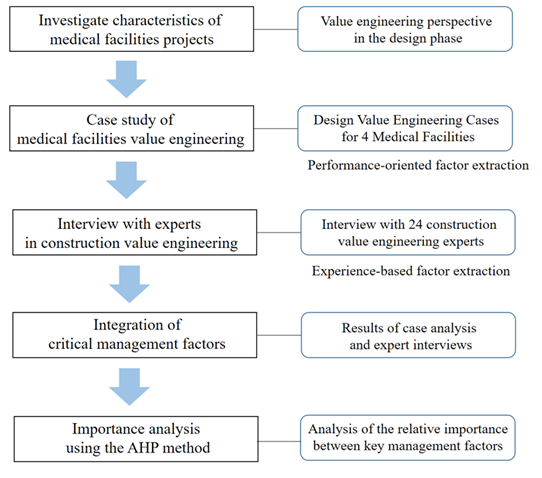
First, in this study, investigate characteristics of medical facilities projects and the work of design value engineering. In this section, this study aims to identify the main characteristics required in medical facility VE work.
Second, we extract the critical factors for the job-plan through a case study of medical facilities value engineering. In this section, this study will conduct an analysis on the cases of four medical facility projects. Specifically, the analysis will cover the entire Job Plan, including the VE results from the basic design phase and the detailed design phase.
Third, in this study, important factors are extracted through interviews with practical experts related to the value engineering work of medical facility projects. In this section, this study will conduct interviews with VE experts who have experience in performing design VE for various construction projects, including medical facilities.
Fourth, in this study, present the results of an importance analysis for extracted critical management factors. In this section, this study will apply the AHP technique, a hierarchical analysis method, to analyze the relative importance of key management factors extracted through case analysis and expert interviews. AHP analysis is conducted for experts with expertise and experience in the VE field and analyzes the relative importance between each extracted item. For this, a pairwise comparison is conducted between each item, and the consistency index, CI, should be 0.1 or less. If the CI value is 0.1 or more, consistency is not secured, so the survey results should be excluded. In this study, expert choice, a specialized program, will be used for AHP analysis.
The above analysis results are expected to provide a reasonable operational model to be used during the design value engineering period.
The role of value engineering is to produce an effective alternative through comprehensive analysis of the economic feasibility and field applicability about the existing design proposal. Value engineering can be divided into four types. First, the value innovation type can reduce costs as well as improve performance. Second, the cost reduction type implements to reduce costs while preserving performance. Third, the function emphasizes type is emphasize the function. Therefore, these types can cause cost increase. Forth, the function improvement type implements to improve function while preserving cost.
The medical facilities project has been shown to have various results focusing on function among the above four VE types. This was analyzed to be due to the fact that medical facilities not only possess project complexity but also require functionality based on diverse spatial configurations. Therefore, it was found that the systematic reflection of owner and user requirements is required during the execution of design value engineering. In this regard, the importance of the quality model construction task, which analyzes the requirements of the client and users, was found to be very high among the tasks of the VE Job-Plan preparation phase.
| Division | Contents | |
|---|---|---|
| Case A | Project Title | OO Hospital Construction Project |
| Location | Yangsan City, Gyeongsangnam-do | |
| Project Size | 28,956 square yards. | |
| Bidding System | Design-Build (DB) | |
| Characteristic | FAST Track Method | |
| Case B | Project Title | OO Children Hospital Construction Project |
| Location | Yangsan City, Gyeongsangnam-do | |
| Project Size | 6,061 square yards | |
| Bidding System | Design-Build (DB) | |
| Characteristic | FAST Track Method | |
| Case C | Project Title | OO Cancer Center Construction Project |
| Location | Seogu District, Busan Metropolitan City | |
| Project Size | 2,700 square yards | |
| Bidding System | Design-Build (DB) | |
| Characteristic | Special Facilities | |
| Case D | Project Title | OO Medical Specialized Center Construction Project |
| Location | Seogu District, Busan Metropolitan City | |
| Size of the project | 8,719 square yards | |
| Bidding System | Design-Build (DB) | |
| Characteristic | Special Facilities | |
In this study, a case study is conducted to extract critical management factors from the design value engineering work of medical facilities. To this end, an analysis method is used to derive critical management factors for each work plan step through value engineering report analysis. Four projects are considered as case projects, and all projects applied the design-build (DB) bidding system. In addition, all the case projects applied a construction management contract system for systematic management, according to the uniqueness of medical facilities. Value engineering was applied to the basic design phase and the execution design phase. An overview of the case projects is presented in Table 1.
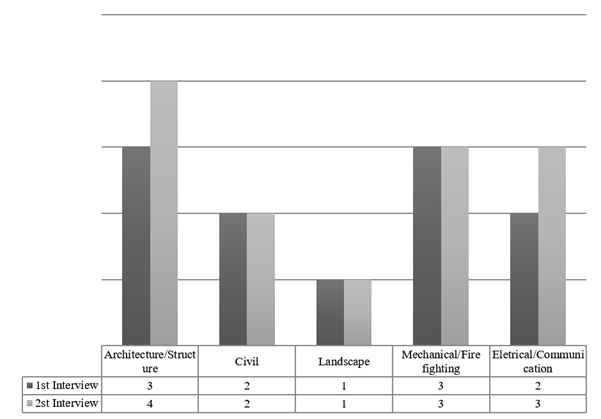
In this section the management factors of each job-plan phase are derived by conducting interviews of value engineering with experts in medical facilities. Expert interviews were carried out on the problem factors in the process of value engineering. The goal of the interview was to extract the management factors required for an efficient value engineering analysis. Interviews were conducted two times each with 24 experts. An overview of the participants is presented in Figure 2.
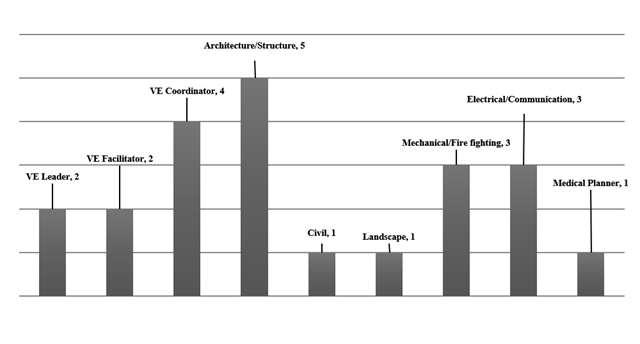
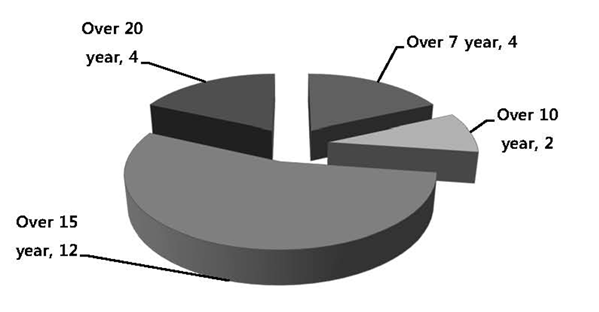
An analytic hierarchy process (AHP) analysis was conducted to analyze the importance of the critical management factors. The AHP analysis includes the critical management factors, value engineering time and value engineering step basis. The AHP analysis was conducted to analyze the relative importance through calculation of weights for the critical management factors. This study surveyed 22 value engineering experts of medical facilities to effectively utilize the AHP technique. Figures 3 and 4 show the area of expertise and career level of the AHP survey participants.
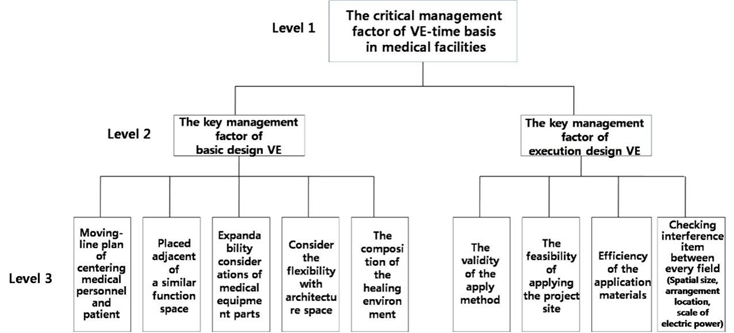
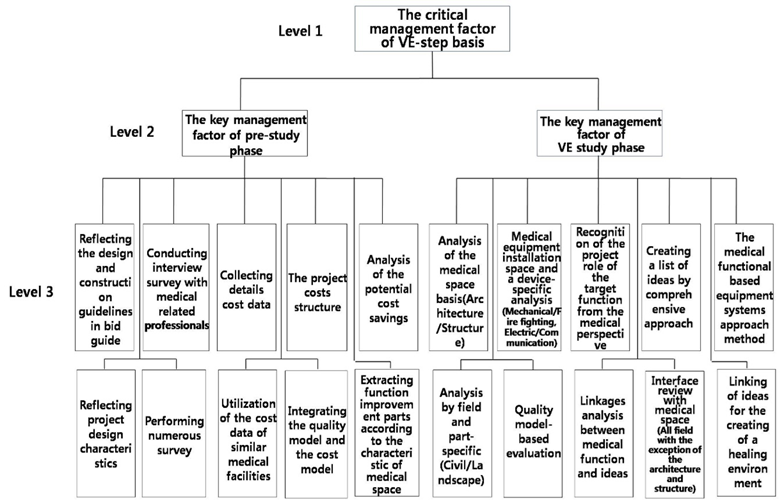
This study established a hierarchy model for nine items of critical management factors based on basic design value engineering and execution design value engineering. The results are shown in Figures 5 and 6.
In the process of applying value management practices, performing the VM procedure step by step is the most important part [13]. Design value engineering is conducted according to the job plan. The utilization techniques of each step of the job-plan are shown in Table 2. Design management (design review and value engineering) work is more important than other tasks in the case of medical facilities, because medical facilities consist of complex and diverse facilities. The value engineering expert therefore should systematically reflect the requirements of the owner and user. In addition, they should create a reasonable alternative to maximize constructability and maintainability.
| Division | Main work | Techniques |
|---|---|---|
| Pre-Study | Composition of design VE review organization | Quality Model Cost Model VE object selection |
| Selecting a design VE object | ||
| Determine the design VE period | ||
| Collection of relating data | ||
| VE Study | Information gathering for | FAST Diagram Matrix Analysis |
| Selected VE objects | ||
| Idea generation | ||
| Idea evaluation | ||
| Alternative embodiment | ||
| Creation of the proposal, and the presentation | ||
| Post-Study | Savings cost estimation based on the design VE results | VE proposals report |
| Submitted to owner all relevant data | Calculated baseline |
In this study, a case analysis was conducted on four medical facility projects, and the specific analysis results are as follows.
The extracted management factors of the basic design and execution design through the case analysis are as follows. Basic design value engineering is approached mainly from a plan perspective. The execution design value engineering object includes a moving-line plan considering medical personnel and patients. In addition, value engineering of this phase should facilitate medical examination and treatment and research through adjacent placement of similar space. Furthermore, mechanical, electrical, and communications equipment require flexibility considering possible future extension of buildings. Landscaping field requires the creation of design alternative through a systematic analysis due to increased importance of rest facilities as a healing space for patients. Execution design value engineering is a confirmed state of a spatial configuration or moving-line plan. Therefore, it is necessary to analyze the detailed system in terms of the feasibility and efficiency of the construction method and materials. It is also important to analyze the linkages through interference consultations for each construction type. Various hospital equipment must be installed in medical facilities due to the characteristics of hospital work. For such medical equipment, an interface analysis with the size and placement of the space depending on the form or purpose should be performed. Through this, a reasonable design for medical facilities can be obtained.
This study extracted management factors, according to a preliminary study and value engineering study of the value engineering job-plan. The results are as follows.
(1) The management factors of the preliminary study phase. The preliminary study phase work of case project was carried out through orientation and meetings, information gathering and analysis, value engineering target selection, etc. This phase was performed centering on the value engineering leader and value engineering facilitator. The core tasks are as follows: establishing a quality model by the owner and user requirements measurement; establishing a cost model; and object selection for an effective function analysis and reasonable idea generation.
From the results of case studies, the following key points were extracted as management items for successful value engineering. First, the quality model determines the level of response for each item through the owner and user requirements measurement. The quality models are then used as a rating scale. In the case of medical facilities, it is difficult to accurately extract the required items due to the numerous stakeholders compared to other projects. Thus, a survey questionnaire should be written after reflecting the design characteristics of the project guidelines in the bid manual. This task is performed to required interview investigation for a project specific consideration. The value engineering team carries out a survey for medical personnel as well as patients and caregivers after completing the questionnaire. Surveys should be performed as much as possible in order to establish precise work standards. Second, the cost model helps to understand the distribution of cost of each construction type.
This model can help value engineering object selection as well as provide cost data for the value engineering team members through the selection of high-cost areas. The value engineering expert should acquire a detailed cost breakdown in accordance with the design drawings from the original designers. In addition, a reasonable selection of value engineering objects is achieved by analyzing cost data and the structure of the cost input based on the project characteristics of similar facilities. Third, the selection of the value engineering object is an important step to establish the approach direction of the function analysis. Therefore, it is necessary to derive cost savings areas with high potential as well as a required part of the functional enhancements, according to the space characteristics after performing a comprehensive analysis of the quality model and cost model.
(2) Management factors of VE study phase. For the value engineering study of case projects a function analysis and evaluation, idea generation and evaluation, writing value engineering proposals report, and calculation of cost data were carried out. The value engineering study was conducted for each construction part centering on the value engineering leader and facilitator. The core work was performed a function analysis (function definitions and classification, Function Analysis System Technique (FAST) diagram, function evaluation) for an emphasis improvement object, function, and idea generation and evaluation to generate effective alternatives. This research derived the following core points in order to perform a successful value engineering through a case analysis.
A function analysis and evaluation is required to select an object to create alternatives to maximize value engineering effectiveness. For this, the value engineering team should consider the diversity and complexity of medical facilities. The contents are as follows. First, the architectural and structural fields must be analyzed space configuration. Second, civil and landscape field must be analyzed for each construction part. Third, mechanical, fire prevention, electrical, and communications must be analyzed in terms of installation space and mechanical device specific. A function evaluation should select evaluation items by type by considering the derived evaluation items from quality models. This stems from the different characteristics in every field. Idea generation must be carried out after recognizing the role of improvement function in the project, because this activity can increase the connectivity of the ideas. In particular, the architectural sector of medical facilities can generate diverse ideas. Thus, idea generation should be conducted in a comprehensive perspective in order to ensure diversity. As a result, the value engineering team can generate diverse ideas by expanding the width of the thinking. Mechanical sector requires a coordinated review with the architectural sector by considering medical equipment. Furthermore, the value engineering team should select the equipment systems by considering the medical functions. In addition, this phase requires systematic landscape plan review to promote a healing environment for the patients due to the nature of medical facilities. The following Table 3 summarizes the analysis criteria items extracted through case analysis.
The expert interview results for each sector are as follows. Architecture and structure field identify the design intent and the problems by a systematic analysis of the basic design and the execution design. Experts presented two key points. First, it is necessary to identify the problems and the design intent through a systematic analysis of the basic design and the execution design. Second, it is necessary to understand the characteristics of the project through an analysis of related data. Furthermore, the experts presented the following two considerations. First, the basic design value engineering should approach the planning aspects such as moving-line and spatial scales. Second, the execution design value engineering should target a detailed systems analysis, such as methods and materials. The experts presented the following two considerations in the civil engineering and landscape fields. First, for the civil field, basic design value engineering should be carried out after a systematic analysis of the surrounding environment through field surveys and geological conditions. Second, execution design value engineering must analyze the feasibility and economics of field application of the derived method through an execution design analysis. Next, the landscape field is an important element of making a healing environment for the patients in a medical facility. Therefore, experts pointed out the necessity of a systematic landscape plan. To do this, the landscape plan should provide an alternative to the project region plant or space plan. The experts proposed about the analyze focusing on harmony with the architecture field. The experts presented the following considerations in the mechanical and fire-prevention fields. A variety of medical equipment must be installed in medical facilities. From this perspective, mechanical and fire-prevention fields require different designs according to the architecture alternatives. Accordingly, the value engineering team should be create design alternative after reflecting the architectural plan scale and medical equipment scale. To reflect the above contents, experts pointed out the necessity of multilateral consultation between every part during the value engineering period. In addition, they noted the necessity of creating a design alternative considering future extension of the building. Electrical and communication aspects are also important, as pointed out by the experts. They are related to the architecture, structure, mechanical, and fire-prevention fields. The experts suggested an interdisciplinary integrated analysis. They also suggested idea generation tasks through a long-term expandability analysis in terms of operational management of facilities. Table 3 summarizes the critical management factors extracted through the case analysis and interviews with experts.
| Division | Content | Application Part | ||
|---|---|---|---|---|
| VE-time basis | Basic Design VE | BD 01. Moving-line plan of centering medical personnel and patient | Architecture | |
| BD 02. Placed adjacent of a similar function space | Architecture | |||
| BD 03. Expandability considerations of medical equipment parts | Mechanical, electrical and communication | |||
| BD 04. Consider the flexibility with architectural space | Architecture, Mechanical, electrical and | |||
| BD 05. The composition of the healing environment | Landscape | |||
| Execution Design VE | ED 01. The validity of the apply method | All field | ||
| ED 02. The feasibility of applying the project site | ||||
| ED 03. Efficiency of the application materials | ||||
| ED 04. Checking interference item between every field (Spatial size, arrangement location, scale of electric power) | ||||
| VE Job-plan basis | Pre-study | Quality Model | PS 01. Reflecting the design and construction guidelines in bid guide | All field |
| PS 02. Reflecting project design characteristics | ||||
| PS 03. Conducting interview survey with medical related professionals | ||||
| PS 04. Performing numerous survey | ||||
| Cost Model | PS 05. Collecting details cost data | All field | ||
| PS 06. Utilization of the cost data of similar medical facilities | ||||
| PS 07. The project costs structure | ||||
| VE Object Selection | PS 08. Integrating the quality model and the cost model | All fields Interface review | ||
| PS 09. Analysis of the potential cost savings | ||||
| PS 10. Extracting function improvement parts according to the characteristic of medical space | ||||
| VE study | Function Analysis and Evaluation | VS 01. Analysis of the medical space basis | Architecture/Structure | |
| VS 02. Analysis by field and part-specific | Civil/Landscape | |||
| VS 03. Medical equipment installation space and a device-specific analysis | Mechanical/Firefighting, Electric/Communication | |||
| VS 04. Quality model-based evaluation | All field | |||
| Idea Generation and Evaluation | VS 05. Recognition of the project role of the target function from the medical perspective | All field | ||
| VS 06. Linkage analysis between medical function and ideas | All field | |||
| VS 07. Creating a list of ideas by comprehensive approach | All field | |||
| VS 08. Interface review with medical space | All fields with the exception of the architecture and structure | |||
| VS 09. The medical functional based equipment systems approach method | All field | |||
| VS 10. Linking of ideas for the creating of a healing environment | All field | |||
| Field basis | Architecture and Structure | AS 01. Identifying design intent and the problem factor | Focusing analysis of architecture and structure Interface review between mechanical and fire-fighting, electrical and communication | |
| AS 02. Understanding the project properties through the analysis of relating data | ||||
| AS 03. The basic design VE: spatial scale, and plan-driven approach | ||||
| AS 04. The execution design VE: Approach for construction methods, materials, and detailed system | ||||
| Civil and Landscape | C 01. Performing function analysis considering the surrounding environment | Civil | ||
| C 02. Considering the feasibility and cost-effectiveness of field application of the method | ||||
| L 01. Centering local species and space planning | ||||
| L 02. Centric approach in harmony with medical facilities | ||||
| Mechanical and Fire-fighting | M/F 01. Consider the scale of medical equipment | Landscape | ||
| M/F 02. Harmonization with medical space planning | ||||
| M/F 03. Interference checks with medical space planning | ||||
| M/F 04. Considering future expansion and extension | ||||
| Electrical and Communication | E/CO 01. Interface review with other parts | Focusing analysis of mechanical and fire-fighting Interface check between architecture and structure | ||
| E/CO 02. Expandability considerations through integrated analysis | ||||
| E/CO 03. Consider the operations management perspective of the medical facility | ||||
| E/CO 04. Review of medical disaster aspects | ||||
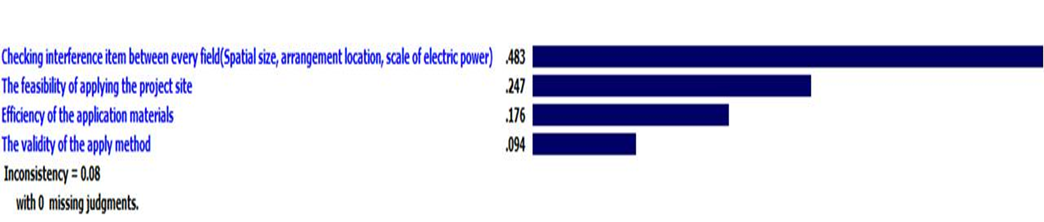
Importance analysis results on the value engineering-time basis are as follows. As shown in Figure 7, a relative importance analysis of the critical management factors of the basic design value engineering was performed. The analysis results appeared in the following order. ”Consider the flexibility with architecture space (0.422)” was the highest.
The next highest was ”Moving-line plan of centering medical personnel and patient (0.269)”. As shown in Figure 8, a relative importance analysis of the critical management factors of the execution design value engineering was performed. The analysis results appeared in the following order. ”Checking interference item between every field (Spatial size, arrangement location, scale of electric power) (0.483)” was the highest. The next highest was ”The feasibility of applying the project site (0.247)”. Importance analysis results on a value engineering job-plan basis were as follows.

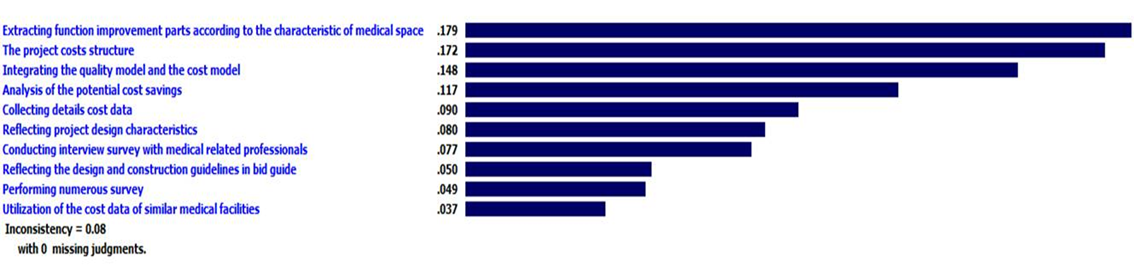
As shown in Figure 9, from the preliminary study, the ranking of importance of the critical management factors was established. From the results ”Extracting function improvement parts according to the characteristics of medical space (0.164)” was the highest. The next were ”The project costs structure (0.153)” and ”Integrating the quality model and the cost model (0.180)”.
As shown in Figure 10, this study calculated an importance ranking of the critical management factors for the value engineering task. The results ”Linking of ideas for creating a healing environment (0.187)” was the highest. The next was ”Interface review with medical space (All fields with the exception of architecture and structure) (0.157)”
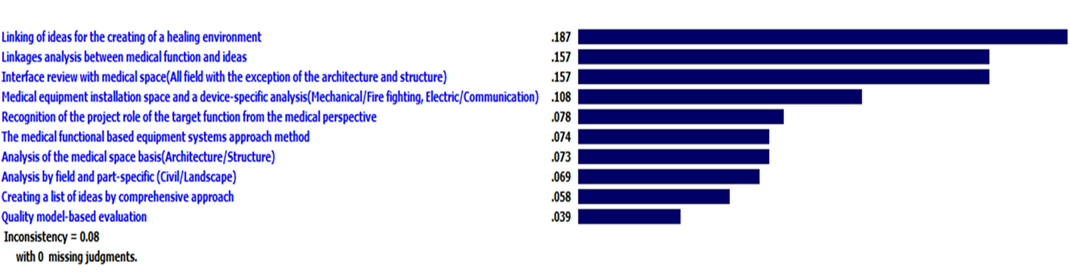
The high importance factors calculated through the AHP analysis had high relevance with the approach method from the point of view of medical facilities. The results of the analysis are shown in Table 4. In particular, Table 4 shows the characteristics of the factors with high importance based on the analysis results of the basic design and execution design. Along with this, Table 4 presents the characteristics of the factors with high importance in pre-study and value engineering study.
| Division | Analysis results | Characteristics of high importance factors | |
|---|---|---|---|
| Critical management factors of VE time basis | Basic design VE | High Importance for related factors in medical space planning, etc. | First, Consider flexibility with architectural space |
| Second, Moving-line plan of medical personnel and patient-centered | |||
| Execution design VE | High Importance for related factors in interface between each field | First, check interface item between each field | |
| Second, feasibility of applying the field | |||
| Critical management factors of VE job-plan basis | Pre-study | High Importance for related factors with VE object selection | First, integrating quality model and cost model |
| Second, Analysis of the potential cost savings | |||
| High Importance for related factors with function analysis task | First, Extracting function improvement field through an analysis of the characteristics of the medical space | ||
| Second, Reflects project design characteristics | |||
| VE study | High Importance of related factors with idea generation, according to the characteristics of the medical facilities | First, linking of ideas for the creation of a healing environment | |
| Second, integration analysis between medical function and ideas | |||
| Third, interface review between medical space | |||
The key considerations for VE at each stage, extracted from the results of this study, are as follows. First, the characteristics of high importance factors during the basic design VE stage were found to consist of the following two points. The first consideration when approaching VE is to conduct various analyses regarding the flexibility of the architectural space from the user’s perspective. The second consideration when approaching VE is to implement a spatial approach that enables treatment planning centered on the movement of medical staff and patients. Next, the characteristics of high importance factors during the execution design VE stage were found to consist of the following two points. The first consideration when approaching VE is to identify interfering interface items for each construction type and analyze efficient linkage methods for them. The second consideration when approaching VE is to examine whether it is possible to apply VE alternatives for each construction specialization fields.
| Division | Existing problems | Application effects |
|---|---|---|
| Job-Plan aspects | Difficulty in reflecting the characteristics of medical facilities | Enhancing VE work efficiency through the provision of analysis criteria based on the characteristics of medical facilities |
| Difficulty in selecting value improvement areas by each engineering part | Enhancing work efficiency by establishing standards for approaches across various engineering fields | |
| Difficulties in applying function analysis | Providing guidelines for efficient functional access to medical facilities | |
| Methodological aspects of VE application | Unclear scope of access for basic design VE and execution design VE | Presenting standards for the approach to basic design VE and execution design VE based on each engineering field |
| Difficulties in collaboration between each engineering fields | Enhancing collaboration capabilities through the presentation and sharing of work directions for each field | |
| Difficulty in reflecting various considerations of medical facility projects | Efficient Analysis of Medical Facility Requirements through the Presentation of a Systematized Quality Model Construction Process |
The key considerations for each stage of the VE Job-plan were analyzed as follows. First, it was found that in the pre-study stage, it is necessary to select VE targets by comprehensively linking and integrating the contents of the quality model and the cost model. Additionally, it is required to extract areas for functional improvement through the analysis of the characteristics of the medical space, and it was found that reflecting the design characteristics of the project during this process is important. Furthermore, it was found that it is necessary to conduct an integrated analysis between medical functions and ideas to empirically analyze their applicability. In addition, it was found that it is necessary to systematically analyze the interface between each medical space to select finishing materials that can increase spatial connectivity. Synthesizing the findings above, it was determined that, unlike other construction projects, medical facilities involve various stakeholders including medical staff and patients, making it crucial to measure the value for the client or users. Therefore, VE practitioners are required to identify the essential requirements of the project through organic communication with these diverse stakeholders. This can be achieved through the systematization of a quality model that approaches owner and user requirements from multiple perspectives and in depth. Furthermore, it was discovered that conducting a systematic functional analysis, along with selecting VE targets that reflect these results, is a critical factor in achieving successful VE outcomes. Consequently, the findings of this study will provide efficient execution methods and standards for each process of the job-plan for design value engineering of medical facilities. Through this, it will drive the creation of reasonable alternatives that meet the requirements of clients and users. The following Table 5 summarizes the expected effects of utilizing the proposed method based on the problems of existing medical facility design value engineering.
Recently, the demand for medical facilities has been continuously increasing due to the aging trend. Medical facilities require systematic project management because they have complex characteristics compared to other projects. Reflecting this trend, large-scale medical facility construction projects are adopting construction management systems. The construction management system applies numerous scientific management techniques. Among other techniques, value engineering is a core technique in terms of cost reduction and performance improvement. From this perspective, the present study extracted the critical management factors of medical facilities value engineering, and the results can be summarized as follows.
First, a value engineering time basis yielded the following results. The basic design value engineering extracted numerous factors associated with the medical space. The execution design value engineering extracted factors related to the applicability of the construction phase. Second, a value engineering job-plan basis yielded the following results. It was confirmed that most of the factors extracted during the preliminary study phase were related to the design characteristics of the project. The value engineering study phase extracted factors associated with a linkage analysis between each field and a medical facilities-based approach. Third, field basis was extracted as critical management factors. As a result, architecture and structure were extracted factors associated with interface between each field. In addition, this research extracted related factors to expandability, constructability, and maintenance. Next, this research performed an importance analysis to extract the critical management factors by the AHP technique. As a result, the value engineering time basis were important associated factors in the linkage analysis between each field considering the characteristics of the medical space. Furthermore, the value engineering job-plan basis showed high importance of associated factors with the idea linkage by systematization of object selection. In addition, the factors associated with the characteristics of project design were of high importance. Until now, there has been no practical study presenting the analysis criteria for job-plan in design value engineering of medical facilities. In this respect, the results of this study are expected to provide guidelines to set standards of medical facilities value engineering work. In addition, the value engineering practitioner can utilize these results to establish an efficient direction for approaching medical facilities value engineering work.