

Within the field of education, it has long been recognised that teaching and learning can be influenced by the physical environment however, this factor often receives less attention in the learning process compared to non-physical variables such as teaching style or educational philosophy [1]. In contrast, the approach taken within environmental psychology is that in relation to learning, the physical environment should be considered as carefully as other aspects of the learning situation. This paper adopts a similar approach by exploring how students experience their school and how their perceptions and behaviour are associated with significant changes to their school environment.
Research investigating the role of the physical environment in the learning and teaching process has a long history however, the quality and impact of this research is highly variable, and several explanations have been proposed to explain this. These include practical issues such as access to schools and users, the timescales involved in significant school building programmes, as well as methodological issues associated with ‘real-world’ research such as specifying the variables to be assessed, identifying suitable tools and securing large, representative samples [2].
Despite these issues, some consistent findings have emerged and one approach to research within this field that has been particularly productive is research that focuses on specific environmental variables within school environments. This research is extensive, multidisciplinary and has looked at a wide range of variables, examples of which include: thermal comfort [3], acoustics [4], colour [5], furniture arrangement [6, 7] and air quality [8]. A comprehensive, literature review on single variable studies such as those by Higgins, et al. [9] concluded, “there is clear evidence that extremes of environmental elements. . . have negative effects on students and teachers and that improving these elements has significant benefits” (p. 6). The review authors conclude that while individual environmental variables are important we should also attend to the interactions of different elements [9]. It is evident that ‘single-variable’ studies have developed our awareness of how specific aspects of the learning environment may impact students. However, a major limitation of this approach is that it fails to recognise that the student experience is rarely determined by a single factor but is instead influenced by the combination of multiple factors. A more recent systematic review [10] found that the presence of colour and pictures, good quality furniture and adequate levels of ambient variable such as acoustics, thermal comfort, ventilation and natural lighting, were important for promoting both wellbeing and performance of users in learning environments.
Consequently, a second approach to school environment research that has emerged in recent years, recognises that the physical environment should be viewed as a holistic unit. In this approach, the level of scale of a ‘unit’ can vary from small (e.g. an individual classroom) to large scale (e.g. the whole school). Research within this approach often focuses on the summative experience of all aspects of the physical learning environment and recognises that this experience is greater than the sum of its parts. Barrett et al. [11] adopted a holistic approach in trying to understand the impact of internal environmental quality on educational performance within primary schools in England and their results provided evidence to support the view that differences in classroom characteristics were related to student performance in reading, writing and maths. Whilst recognising the value of these findings, the researchers acknowledge that the results may be constrained by the geographical and pedagogical context of the study. A further limitation of this study is that since the research was conducted within primary schools, it may have limited applicability to secondary schools.
Based on the two contrasting approaches to research on school environments that we have identified, this study follows the second, ‘holistic’ approach. However, whilst Barrett et al. [11] defined the holistic unit as the classroom, we define the holistic unit as the whole school. Our justification for this is because we are conducting research within secondary schools where students experience a range of different spaces within their school daily. In contrast the research by Barrett et al. was conducted in primary schools where the student experience is essentially based on one classroom.
We also identify an additional strand of research in this area by developing an awareness of the dynamics of changing school environments, namely, that the impact of modifying existing or creating new school environments is likely to be dependent on the characteristics of different groups of students (e.g. age) and the nature of the actual environmental change (e.g. renovation v new build). For example, Edgerton et al. [12] found that students’ and staff perceptions of their new school environment were related to the degree of change in the school environment and that students whose school was completely rebuilt had more positive perceptions of their school than students whose school had undergone a major refurbishment. The study also highlighted that perceptions of the new school were not universally positive and that we should be cautious about assuming that ‘new means better’. One weakness of this study that the researchers recognised was that the data on the ‘old’ school environments was retrospective in nature and was based on a limited, ad hoc measure of the physical school environment.
A later study by the same researchers addressed these concerns by focusing specifically on how students understood and perceived their school environment [13]. This research involved conducting a series of focus groups with students in secondary schools in Scotland. The findings illustrated that when students were asked about their school environment, they adopted a holistic view rather than taking a purely ‘classroom-based’ perspective. The data from the focus groups was then used to develop a survey tool, the Physical School Environment Questionnaire (PSEQ) that measured students’ perceptions of their whole school environment as well as other variables such as ‘in-school behaviour’ and students ‘self-perceptions’. Subsequent large-scale studies have supported the validity of the tool as a means of measuring how students perceive their school environment [14].
In summarising the above studies, it is clear that while the body of work within this holistic approach is growing, there is a need for additional studies to evaluate how students experience their physical school environment. In addition, much of the research in the field has focused on single schools or single groups/cohorts of students. This limits the ability to generalise the findings from these samples and fails to recognise that schools include students of different age groups that are likely to have different developmental needs and associated differences in their perception of their school environment.
A further limitation of research in this field is that we know little about how changes to the school environment are experienced by students at different points in time (i.e. whether changes to the school environment are associated with changes in student ‘behaviour’ and whether any changes in behaviour endure beyond an initial ‘boost’ of the new building which might be a ‘novelty effect’). Acknowledging that the effect of change is likely to fluctuate over time necessitates the use of a longitudinal research design. However, longitudinal designs are rarely employed in ‘real-world’ research due to several methodological challenges. Firstly, collecting data from the same students over time will often not be possible as students may have left the school by the time of later data collection phases. Secondly, even if the same students attend the school throughout the data collection period, they will have changed developmentally during this period and therefore any changes in student behaviour and experience may be due to other, non-environmental factors. Finally, longitudinal designs need to be aware of, and account for other variables that may have changed over the data collection period and that could offer alternative explanations for the results. Our study addresses these methodological challenges by adopting a large scale, survey approach across different cohorts of comparable students at different points over a seven-year period (that includes a major change to the school environment). In addition, we were able to obtain information on the degree of change in other key (non-environmental) variables during this time frame. By adopting this methodological approach, we can assess students’ perceptions of their school environment and important educational outcomes, whether these are associated with changes to the school environment, and whether there are variations between different student year groups. The implementation of this research design is rare within this field and allows us to address questions about a ‘novelty effect’.
This study will focus on different versions of a secondary school estate in Scotland resulting from a re-building programme. The different versions of the school estate are the original school estate, the new school estate one year after it was completed and the new school estate four years after it had been completed. The overall aims of the study are to firstly, explore how the different versions of the school estate are perceived by students and secondly, whether the different versions of the school estate are associated with changes across a range of student-centred educational outcomes. In addressing these aims, we proposed the following hypotheses:
The new versions of the school estate will be perceived significantly more positively by students compared with the original version of the school estate.
The new versions of the school estate will show a significant improvement across a range of student educational outcomes compared with the original version of the school estate.
The study was conducted with a Local Authority in Central Scotland that was undertaking a £100million secondary school rebuilding project. In Scotland such schools accommodate students between 12-17 years of age, and this project focused on five schools. The motivation for the rebuild was the need to meet changes in building regulations and to build on existing success within the schools by developing new learning environments. The primary design improvements to be included were: “break out” areas (for one to one teaching); all subjects (with the exception of physical education) to be delivered in one centralised main building; wider corridors with natural lighting; indoor and outdoor social areas to be available in all schools; toilets to be located at the “hub” of each school (i.e. social areas); schools to provide lockers for students to store belongings and a greater amount of outdoor provision.
For the purposes of this paper, we will look at the data that was collected across three different ‘versions’ of the schools:
‘Original’ school estate – 2 months before construction work started
‘New’ school estate – 10 months after the schools had been completed
‘New+’ school estate – 46 months after the schools had been completed
For each of the three versions of the school estate outlined above, data was aggregated across all five schools.
Data was collected using the PSEQ1. This questionnaire consists of scales that were developed by the authors to measure students’ perceptions of their school environment and their ‘in-school behaviour’, and several existing standardised scales to measure other, relevant educational outcomes. The PSEQ consisted of three sections.
The first section measured key aspects of the physical school environment. This was created based on information obtained from a series of focus groups conducted with students in two of the schools involved in the school re-building programme (for further details see McEwen at al. [14]). There were sixty items in total relating to the school environment and students were required to rate these on a five-point Likert scale from ‘very poor’ through to ‘very good’. Items were grouped into ten distinct areas of the physical school environment namely: attractiveness of the outside of the building, places to meet friends inside the school; corridors and stairs, standard classrooms, non-standard classrooms, toilets, indoor sports facilities, outdoor sports facilities, dining facilities and security. The items showed good internal reliability (Cronbach’s alpha = 0.971) and for the purpose of this study, we produced a ‘Global School Environment’ (GSE) score by summing the average score across all sixty items.
The second section measured several important ‘in-school behaviours’ and again this was based on information obtained from the same series of focus groups. Four categories of behaviour were identified, and students were asked to rate how often they performed a range of behaviours on a four-point scale ranging from ‘never’ through to ‘always’. The four categories of ‘in-school behaviour’ were: Engaging Behaviour (10 items), Negative Behaviour (3 items), Environmental Difficulty (7 items) and Security (5 items). All sub-scales had acceptable levels of reliability as indicated by the following Cronbach’s alpha coefficients: Engaging Behaviour (0.712), Negative Behaviour (0.677), Environmental Difficulty (0.652) and Security (0.653).
The final section of the questionnaire measured three psychological variables relevant to the student learning and teaching context. These were measured using the following standardised instruments. Firstly, academic self-esteem was defined as “students’ evaluations of themselves in school” and was measured using the Piers and Harris [15] Intellectual School Status sub-scale. Secondly, global self-esteem was defined as “students’ thoughts and feelings about themselves in general” and was assessed using Rosenberg’s [16] Global Self-Esteem Scale. Finally, learning goals were measured using Midgely, et al. [17] Patterns of Adaptive Learning Scale. The latter scale assessed three different learning goals: (i) Mastery approach – this is viewed as a positive approach to learning where the desire to master the task at hand is a key factor (ii) Performance approach- where students attempt to show that they can perform as well or better than their peers, while generally viewed as a beneficial approach there is some debate about whether this is a positive or negative orientation (iii) Performance avoidance – an approach considered to be maladaptive, where students avoid participating in class to avoid failing. As expected, all standardised scales had good levels of reliability as indicated by the following Cronbach’s alpha coefficients: Academic self-esteem (0.771), Global self-esteem (0.856), Learning goals: Mastery Approach (0.854), Performance Approach (0.846) and Performance Avoidance (0.696).
In summary the results of these analyses support the robustness of the survey tool in terms of its reliability.
The study collected data from five schools that were part of the rebuilding programme, and the target population was all students in S1 (1st Year), S3 (3rd Year) and S5 (5th Year); approximately 12, 14 and 16 years of age, respectively. Having obtained Local Authority and University ethics approval for the project, the survey was carried out in each school, either in individual registration classes or in the main assembly area with all students from the relevant year group present. Researchers were available in all settings to distribute and collect the questionnaires and answer any questions that students might have.
The data was collected across the three different ‘versions’ of the schools identified above, and the response rates are given in Table 1.
| Student Year Group | Old School Estate | New School Estate | New+ School Estate |
|---|---|---|---|
| S1 | N = 668 (84%) | N = 634 (87%) | N = 656 (91%) |
| S3 | N = 756 (84%) | N = 581 (77%) | N = 654 (86%) |
| S5 | N = 257 (60%)2 | N = 355 (49%) | N = 465 (67%) |
| TOTAL | N = 1681 (76%) | N = 1570 (71%) | N = 1775 (81%) |
2 due to an administrative problem, two schools did not provide any S5 students at phase 1; the percentage figure therefore represents the response rate based on the three schools where data was collected.
In total, across all year groups in each of the five schools and all different versions of the school estate, 5026 students completed the questionnaire. However, since the cohort of students is different across each version of the school estate, all data in this study will be analysed as if it was independent, both across different versions of the school estate and different cohorts of students. In summary therefore, the data is based on a comparison between comparable cohorts of students at three different points in time. Based on data provided by the Local Authority, we established that the cohorts are comparable because of the consistency throughout the data collection period in both student characteristics (school roll and socio-demographic background) and teacher characteristics (Head Teacher for each school, total number of teachers in each school, and teacher turnover). In addition, whilst Scotland has a national curriculum called the Curriculum for Excellence (CfE), the responsibility for how this is delivered lies with Local Authorities and therefore any variation is likely to occur between and not within, Local Authorities. In short, the major change in these schools over the time period concerned is the building of the new versions of the school estate.
Given the sample sizes involved, many small differences will be statistically significant and therefore it is more appropriate to look at the effect sizes. However, it is also the case that many small effects will be statistically significant, and we have therefore decided only to focus on effect sizes greater than 0.1. In addition, we have categorised the effect sizes as: small = 0.1-0.25, moderate = 0.26-0.45 and large >0.45 [18].
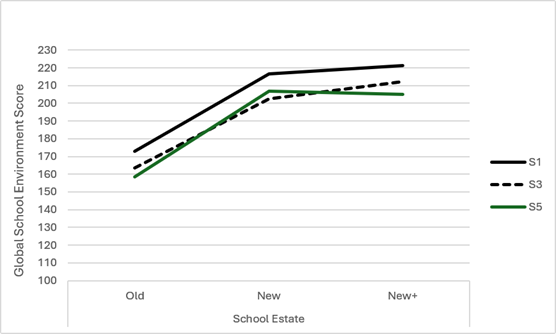
Figure 1 displays the mean GSE scores for the three versions of the school estate across all three student year groups.
For the GSE scores, a two-way ANOVA (with school estate version and student year group as factors) was conducted and this showed a significant increase by school estate version with a large effect size (F(2,5006)=1126.7, p<0.001, effect size (r)=0.56). Individual contrast tests showed that the increase in mean score from the ‘Original’ school estate to the ‘New’ school estate was significant and that the increase in mean score from the ‘New’ school estate to the ‘New+’ school estate was also significant although not as large.
There was also a small but significant student year group effect with S1 scoring significantly higher than other years (F(2,5006)=92.9, p<0.001, effect size (r)=0.19). All years showed similar patterns across different versions of the schools although the S5 mean score dipped slightly between the ‘New’ school estate and the ‘New+’ school estate.
These results clearly indicate that students’ perceptions of the ‘New’ and ‘New+’ versions of the school estate were significantly higher than the ‘Original’ version of the school estate. This demonstrates that the new versions of the schools that were built were perceived more positively by students and that these positive perceptions persisted at different points in time (i.e. 46 months after the new schools had been completed). These results therefore support the first hypothesis.
Whilst the results presented so far indicate that students perceive the new versions of the school estate as significantly better than the original version, they do not address the reasons behind these findings, or what we might think of, as the ‘why’ question. In order to respond to this question, we can draw on two further sources of data: (i) we can consider a more nuanced understanding of the school environment by examining students perceptions of different aspects of the school environment, rather than simply focussing on the GSE (ii) the PSEQ also obtained qualitative data from students by asking them to list the three best and worst features of their school environment.
Not surprisingly, the quantitative data on the different aspects of the physical environment revealed some between-school variation however, there was also substantial consensus on the aspects that showed the greatest improvement. Across all schools, the aspects of the physical environment that showed the greatest improvement, were (in order): the toilet facilities, the outside of the building, the corridor and stairs and security. The aspects that showed the least improvement, were (in order): the indoor sports facilities, the dining facilities and the non-standard classrooms. Overall, the highest rated aspect of the physical school environment across all schools was the outdoor sports facilities and the lowest rated was the dining facilities and spaces to meet friends inside the school.
When we look at the qualitative data from the survey, this again shows some between-school variation. However, there was also considerable consensus, with the sports facilities being most frequently mentioned as the best aspect and the lack of seating in social areas being most frequently mentioned as the worst aspect. We will return to the ‘why’ question in the discussion section.
For all outcome variables with the exception of Negative Behaviours a series of two-way ANOVAs were conducted with school version and student year group as factors (due to violations of parametric test assumptions, Negative Behaviours was analysed using non-parametric tests). For the purposes of this paper, this section will only focus on the results relating to the factor of the school estate version. Table 2 summarises the results of these analyses for the school version factor across all nine outcome variables.
| Outcome variable | p-value | Effect size | |
|---|---|---|---|
| ‘In-school behaviour’ | Engaging Behavior | p<0.001 | 0.18 |
| Environmental Difficulty | p<0.001 | 0.19 | |
| Security | p<0.001 | 0.49 | |
| Negative Behaviors | p<0.001 | 0.12 | |
| Learning Goals | Mastery Approach | p<0.001 | 0.19 |
| Performance Approach | p<0.001 | 0.14 | |
| Performance Avoidance | p<0.001 | 0.05 | |
| Self-esteem | Global Self-esteem | n.s. | N/A |
| Academic Self-esteem | p<0.001 | 0.09 |
The first set of educational outcomes were the four ‘in-school behaviours’. For Engaging Behaviour, Environmental Difficulty and Negative Behaviours, there was a significant difference by school estate version with a small effect size. For Security, there was a significant difference by school estate version with a large effect size. Individual contrast tests showed that for all four ‘in-school behaviours’, the improvement (increase or decrease depending on the outcome variable) from the ‘Original’ version of the school estate to the ‘New’ version of the school estate was significant and that the improvement from the ‘New’ version of the school estate to the ‘New+’ version of the school estate was also significant although not as large.
The second set of educational outcomes were the three types of learning goals. For Mastery Approach and Performance Approach, there was a significant difference by school estate version with a small effect size. Individual contrast tests showed that for both learning goals the increase from the ‘Original’ version of the school estate to the ‘New’ version of the school estate was significant but that the increase from the ‘New’ version of the school estate to the ‘New+’ version of the school estate was only significant for Mastery Approach. For Performance Avoidance, there was a significant difference by school estate version however, the effect size falls below our reporting criteria.
The final set of educational outcomes that were measured were the two types of self-esteem (academic and global). For Academic Self-Esteem, there was a significant difference by school estate version however, the effect size falls below our reporting criteria. For Global Self-Esteem, there was no significant difference by school estate version.
Based on our approach of only discussing any effect sizes that are greater than 0.1, we can summarise the results as follows:
There was a large improvement in students’ perceptions of the ‘global’ school environment (GSE) in the ‘New’ and ‘New+’ versions of the school estate compared with the ‘Original’ school estate; this improvement was greater for S1 students.
There was a large decrease in students’ concerns about security in the ‘New’ and New+’ versions of the school estate compared with the ‘Original’ school estate.
There were small improvements in Engaging Behaviour (increase), Environmental Difficulty (decrease), Negative Behaviour (decrease) and Mastery Approach (increase) in the ‘New’ and ‘New+’ versions of the school estate compared with the ‘Original’ school estate.
In terms of how students perceived their school environments, the results demonstrate support for the first hypothesis. The new versions of the school estates are perceived as being significantly better than the original school estate. In addition, these perceptions are maintained at the different time points in the study across all three different cohorts of students with the highest perceptions of the school environment found in the ‘New+’ versions of the school estate (almost four years after the new schools had been completed). These findings allow us to address a limitation that was identified in previous research on new or ‘renewed’ school environments, namely, that more positive perceptions of the new school estate, endure over time and are not simply attributable to a ‘novelty effect’. The more positive perceptions are a consequence of actual improvements to the physical environment and in particular, improvements to the toilet facilities, the outside of the school building and school grounds, the circulation spaces and personal security. Whilst the schools in this study were completely rebuilt, the changes across all schools were more substantial in some aspects of the environment than others. For example, compared with the old school estate, the corridors and circulation spaces in the new versions of the school estate were wider with natural lighting and views to the outside and the toilet facilities were also larger and centrally located next to the main social areas. In contrast, the classrooms in the new school estate were similar in size and arranged in the same way as the old school estate and it is noticeable that the classrooms were absent from the students’ list of areas showing the greatest improvement; we believe that the reason for this is that the changes to these areas were limited and more cosmetic in nature. We would therefore argue that the degree of change to the physical school environment was a significant factor influencing students’ perceptions. Finally, it is worth highlighting that the substantial changes to areas such as toilet facilities, corridors and circulation spaces may contribute to the large decrease in students’ concerns about security in the ‘New’ and ‘New+’ versions. The design of these areas in the new school estate is likely to reduce the potential for bullying and accidental infringements of personal space.
Whilst the substantial improvements in students’ perceptions of the new versions of the school estate is evident across all three year groups, the findings also indicate a degree of variation between the year groups. This supports the conclusions by Stewart [19] and Russo et al. [20] that between group differences are important factors to consider when investigating users’ perceptions of their physical environment. Our results revealed a small but significant year effect with S1 scoring significantly higher than the other year groups. This supports previous findings [13] that suggest that first year students are more positive about their school environments, which may be attributable to a ‘halo effect’. When students begin secondary school, they encounter a new physical and social environment with new teachers, new students, new subjects and new styles of teaching. It could be the case that S1 students perceive such changes positively and that this in turn influenced their evaluations of the physical school environment overall. Although the transition to secondary school might be considered challenging [21, 22], research commissioned by the Scottish Government found some evidence that students experience an initial decline in wellbeing outcomes but then adjust relatively quickly to the transition [23]. It should be noted that all data collection in this study was conducted towards the end of the academic year. These findings are in line with other research which suggests that in terms of how they perceive their school environment, secondary school students should not be considered as a homogenous group [24, 25].
The final set of analyses focused on whether the different versions of the school estate were associated with differences across a range of educational outcomes. In total there were nine outcome variables: four ‘in-school’ behaviours (Engaging Behaviour, Environmental Difficulty, Security and Negative Behaviour), three learning goals (Mastery Approach, Performance Approach and Performance Avoidance) and two measures of self-esteem (Academic and Global). The results from these analyses demonstrated that in comparison with the original school estate, the new versions of the school estate resulted in statistically significant changes on five of the nine educational outcomes. There was a large decrease in students concerns about Security, small improvements in Engaging Behaviour (increase), Environmental Difficulty (decrease), Negative Behaviour (decrease) and Mastery Approach learning goals (increase). Across all outcomes, this positive effect was evident in the ‘New’ and ‘New+’ versions of the school estate although the positive change between the ‘New’ and ‘New+’ versions was smaller than the difference between the ‘Original’ to ‘New’ version of the school estate. These results offer partial support for the second set of hypotheses. The new versions of the school estate resulted in small, but significant improvements in most of the educational outcomes and where change did occur, it was maintained in the ‘New+’ version of the school estate (i.e. almost four years after the changes were completed). This allows us to reject a ‘novelty effect’ explanation for these educational outcomes and instead suggests a consistent (and in some cases, a larger) effect of the school environment at the different time points in this study. Statistically significant improvements were found in five of the educational outcomes and whilst most of the effect sizes were small (except for ‘Security’), we would argue that the pattern of findings points to the breadth of improvement across several areas, rather than a focus on any single outcome.
As previously noted, students felt safer and more secure in the new versions of the school estate. Overall, this is an important finding as the national curriculum for Scottish schools for learners from age 3 to 18 includes a responsibility for promoting an atmosphere of safety and security for young people and as such, this is an important educational outcome within the Scottish educational system [26].
The changes to the social and circulation spaces are also likely to have contributed to the moderate decreases found in Environmental Difficulty. Most scale items relating to this outcome were concerned with the difficulty in moving around the school due to a lack of space and the layout of the school.
From an educational point of view, it was encouraging to note the small improvement in Engaging Behaviour combined with the small improvement in the use of Mastery Approach learning goal and the small decrease in Negative Behaviour. Overall, this suggests that students in the new versions of the school estate are more likely to work harder in school, make greater use of the school’s facilities, adopt a positive approach to learning where they want to master the task at hand and are less likely to miss classes and misbehave in class. Although this paper has not assessed the academic performance of students, it is conceivable that these positive changes might have a positive impact on attainment.
A final point to note in relation to the educational outcomes was that the new versions of the school estate had no impact on either academic or global self-esteem. Whilst these results are perhaps not surprising in relation to global self-esteem as it likely to be affected by many factors not related to school, the results for academic self-esteem are surprising.
Research has shown that students perceptions of their school climate (which includes physical characteristics such as cleanliness, order and maintenance) was related to their self-esteem [27] and that well-maintained, attractive school environments are likely to indicate to students that they are valued [28].
Based on these arguments we hypothesised that the new versions of the school estate would enhance students’ academic self-esteem (i.e. how they evaluate themselves within an educational context). However, despite this argument, our findings do not support the link between the school estate and how students’ value themselves based on a standardised measure of academic self-esteem.
One potential criticism of our study is that since it was based on ‘real-world’ research that collected data at different points in time, there may be several alternative explanations (not connected with the new versions of the school estate) that could explain the positive pattern of results. Of these the most obvious are changes in school policies, student demographics, the curriculum and leadership within the schools. As mentioned earlier, our discussions with the Local Authority and the schools involved, confirmed that the student demographic has remained constant throughout the study and that there have been no significant changes in school policies, curriculum design, staff turnover or leadership. In short, we are confident that the most plausible explanation for the results in this study is the change from the original version of the school estate to the new version of the school estate.
Another potential criticism of the study is that students’ more positive perceptions of their new school estate is simply a result of a ‘Hawthorne Effect’. However, we should be mindful of the fact that the usefulness of this effect is contested by some researchers (e.g. Chiesa & Hobbs, [29]). A key aspect of these criticisms is the confusion over the use of the term. In the context of this paper, we consider the ‘Hawthorne effect’ to be related to students modifying their behaviour in response to their awareness of being observed [30]. We believe that there are several aspects of our data that would allow us to challenge such an interpretation of our findings. For example, the outcomes (student behaviour) associated with the new versions of the school estate were not universally positive and instead there was differentiation in these outcomes; for instance, there was no change in students’ self-esteem or some of their learning goals. Secondly, unlike the ‘Hawthorne Effect’, where the positive effects were short lived, the outcomes in our study were maintained in the ‘New+’ school estate, i.e. four years after completion.
There is one limitation of our study that is worth noting. At this stage, our study does not include data on educational attainment. Given our current findings, we might anticipate that the new versions of the school estate would have a positive impact on educational performance, however, accessing accurate, consistent data on educational attainment is challenging within the context of this study. In Scotland, national, standardised measures of academic performance in secondary schools are only available in the final three years of school (in our study this would only apply to S5 students). Future studies could seek to explore this relationship, but we would concur with the prevailing view in Scotland that education is more than simply about educational attainment. This view is supported internationally by researchers that have recently argued the need for measuring outcomes other than academic achievement, such as motivation, positive behaviour and educational engagement [31].
The findings make two major contributions to our understanding of how changes to the physical environment of schools are experienced by students. Firstly, by addressing the limitations inherent in previous research in this area we can have confidence in claiming that renewing school buildings is associated with positive changes across a range of student ’educational outcomes. Secondly, by collecting data from different cohorts of students in the ‘Old’, ‘New’ and ‘New+’ versions of the school estate, we are able to demonstrate that this positive association is maintained and cannot be explained by any ‘novelty effect’.
For educationalists and policy makers, the study highlights the importance of investing in school environments. Learning spaces should be considered in terms of their functional ability and their psychological impact on students. The study also draws attention to the need to develop a greater awareness of the relationship between educational environments, students learning and the aims of the curriculum. As such we should acknowledge the role of the school environment on students’ educational journey.
The following statements ask you to rate different features of your school. Please rate each statement by ticking the box that best represents what you think on a scale from “very poor” to “very good”.
| Very Poor | Poor | Average | Good | Very Good | |
|---|---|---|---|---|---|
| Attractiveness of the school building | |||||
| Attractiveness of the school grounds/ playground | |||||
| Amount of space | |||||
| Places to sit | |||||
| Comfortable places to sit | |||||
| Choice of places to meet friends | |||||
| Places to relax |
| Very Poor | Poor | Average | Good | Very Good | |
|---|---|---|---|---|---|
| Attractiveness of meeting places | |||||
| Amount of space | |||||
| Places to sit | |||||
| Comfortable places to sit | |||||
| Choices of places to meet friends | |||||
| Places to relax |
What are the best and worst aspects of these social places in your school building and school grounds?
Best: ________________________________________________
Worst: ________________________________________________
| Very Poor | Poor | Average | Good | Very Good | |
|---|---|---|---|---|---|
| Attractiveness | |||||
| Amount of space |
| Very Poor | Poor | Average | Good | Very Good | |
|---|---|---|---|---|---|
| Attractiveness | |||||
| Ability to see the board | |||||
| Ability to see the teacher | |||||
| Ability to hear the teacher | |||||
| Noise from outside (N.B. very poor = disruption to the class) | |||||
| Temperature | |||||
| Comfortable furniture | |||||
| Ability to move around the class | |||||
| Amount of space | |||||
| Layout/arrangement of classroom |
| Very Poor | Poor | Average | Good | Very Good | |
|---|---|---|---|---|---|
| Attractiveness | |||||
| Ability to see the board | |||||
| Ability to see the teacher | |||||
| Ability to hear the teacher | |||||
| Noise from outside (N.B. very poor = disruption to the class) | |||||
| Temperature | |||||
| Comfortable furniture | |||||
| Ability to move around the class | |||||
| Amount of space | |||||
| Layout/arrangement of classroom |
| Very Poor | Poor | Average | Good | Very Good | |
|---|---|---|---|---|---|
| Attractiveness | |||||
| Amount of space | |||||
| Location of toilets | |||||
| Number of toilets |
| Very Poor | Poor | Average | Good | Very Good | |
|---|---|---|---|---|---|
| Attractiveness of the changing rooms | |||||
| Attractiveness of the Gym/Sports Hall | |||||
| Temperature of Gym/Sports Hall | |||||
| Ability to see the teacher | |||||
| Ability to hear the teacher | |||||
| Amount of space | |||||
| Ability to move around | |||||
| Suitability of Gym/Sports Hall for different sports |
| Very Poor | Poor | Average | Good | Very Good | |
|---|---|---|---|---|---|
| Attractiveness | |||||
| Number of outdoor pitches | |||||
| Condition of outdoor pitches | |||||
| Location of outdoor pitches |
| Very Poor | Poor | Average | Good | Very Good | |
|---|---|---|---|---|---|
| Attractiveness | |||||
| A place to meet friends | |||||
| Availability of places to sit | |||||
| Comfortable seats/ tables | |||||
| A place to relax | |||||
| Amount of space |
| Very Poor | Poor | Average | Good | Very Good | |
|---|---|---|---|---|---|
| Personal safety within the school building | |||||
| Personal safety in the school grounds | |||||
| Storage for personal belongings |
1. ________________________________________________
2. ________________________________________________
1. ________________________________________________
2. ________________________________________________
Since the full survey included copyrighted scales, we have included a copy of the PSEQ in Appendix 1 without these scales.